Carpal tunnel syndrome
Carpal tunnel syndrome is compression of the median nerve at the wrist. It causes tingling in the thumb, index and middle fingers, typically at night. When symptoms persist despite non-surgical treatment, or when the nerve is suffering, a short day-case operation, often under local anaesthesia, releases the nerve.
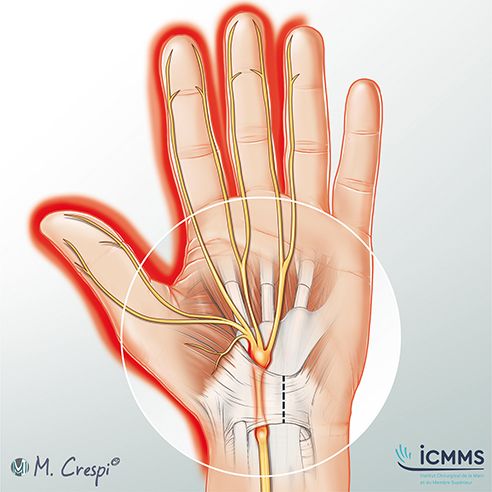
What is the carpal tunnel?
The carpal tunnel is a passage on the palm side of the wrist, between the carpal bones and a thick ligament, the transverse carpal ligament. It contains the finger flexor tendons and the median nerve. When pressure rises inside the tunnel, the median nerve is compressed.
In most cases no specific cause is found: this is called idiopathic carpal tunnel syndrome. It is more common in women after the menopause and often affects both hands. Some conditions favour compression: inflammation of the flexor tendon sheaths, after-effects of a wrist fracture, rheumatoid arthritis, pregnancy, hypothyroidism or diabetes.
What are the symptoms?
- Tingling, numbness or "electric shocks" in the thumb, index, middle finger and half of the ring finger
- Night-time symptoms that wake you up, relieved by shaking the hand
- Discomfort during prolonged activities: holding a phone, driving, reading
- In advanced stages: permanent loss of sensation, clumsiness, dropping objects, wasting of the muscle at the base of the thumb
How is it diagnosed?
Diagnosis is based on your history, clinical examination and an electromyogram (EMG, nerve conduction study). The EMG confirms the compression, measures its severity and rules out another cause. It is requested in every case; ideally, have it done before the consultation and bring the report. An ultrasound scan may complete the assessment.
What are the non-surgical treatments?
In early forms, a resting splint worn at night, which holds the wrist in a neutral position, and a corticosteroid injection can provide relief. Their effect is sometimes temporary.
When is surgery needed?
Surgery is offered when symptoms persist despite non-surgical treatment, when they affect sleep or work, or straight away when there is permanent loss of sensation or muscle weakness. Waiting too long carries a risk of incomplete nerve recovery.
How is the operation performed?
The operation consists of dividing the transverse carpal ligament to give the median nerve more room. It usually takes about fifteen minutes and is done as a day case: you go home the same day.
It can be performed under wide-awake local anaesthesia with no tourniquet (WALANT): you stay awake, with no drip and no tourniquet on the arm. Regional anaesthesia of the arm is an alternative. The choice is discussed in consultation.
After the operation
- The fingers can be used straight away for light everyday activities
- Night-time tingling often disappears in the first few days; recovery of sensation is slower and depends on how long the nerve was compressed
- Tenderness of the palm when leaning on it ("heel of the hand" pain) is common for 2 to 3 months
- Time off work depends on your job: from a few days for office work to several weeks for heavy manual work
Complications are rare: infection, haematoma, stiffness or complex regional pain syndrome. They are explained to you in consultation.
Frequently asked questions
Is carpal tunnel surgery painful?
Under local anaesthesia, only the initial injection is felt. Recovery is usually not very painful and is well controlled with simple painkillers.
Can both hands be operated on at the same time?
It is possible in some cases, but it limits your independence for a few days. Most often one hand is operated on, then the other a few weeks later.
Can carpal tunnel syndrome come back after surgery?
True recurrence is rare. Persistent symptoms more often reflect a nerve that is recovering slowly after long-standing compression.
Do I need an EMG before the consultation?
Yes, ideally. The EMG is essential for diagnosis and for choosing the treatment: having it done beforehand means a decision can be made at the first appointment. Your GP can prescribe it.
Consultations in Lyon
Dr Maxime Cievet-Bonfils sees patients at:
- ICMMS – Centre Eiffel, 18-20 rue Tronchet, 69006 Lyon (3rd floor)
- Clinique de l'Infirmerie Protestante, 3 chemin du Penthod, 69300 Caluire-et-Cuire (Building D, 4th floor)
Secretary (direct line): +33 4 87 25 83 35 · Consultations in French or English.
This page provides general information. It does not replace a consultation: every situation is different.