Complex regional pain syndrome (CRPS)
Complex regional pain syndrome (CRPS) is an abnormal reaction of the nervous system that most often occurs after an injury or an operation on the hand or wrist. It combines disproportionate pain, swelling, skin changes and then stiffness. Its treatment is not surgical: it relies on early diagnosis, gentle and regular rehabilitation, and appropriate pain management. It usually resolves, but slowly.
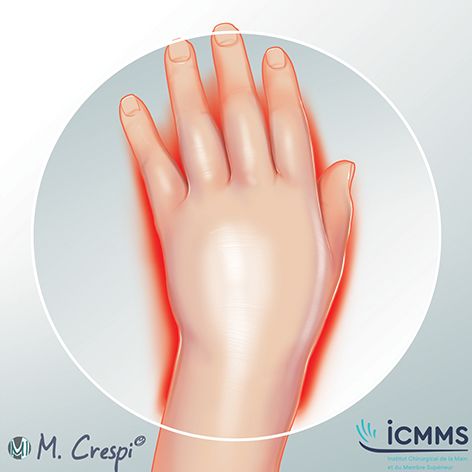
What is complex regional pain syndrome?
After an injury, pain and swelling normally decrease within a few weeks. In complex regional pain syndrome, the reaction goes wrong: the nerves that control pain, blood circulation and sweating go into overdrive, and the pain becomes greater and longer-lasting than the initial injury would warrant. Its exact mechanism is still poorly understood; it involves the peripheral and central nervous system as well as a local inflammatory reaction.
It can appear after a fracture (in particular a wrist fracture), a sprain, an operation, and sometimes a very minor injury. There are two types:
- type 1, the most common, with no identified nerve injury
- type 2, which follows a nerve injury
Complex regional pain syndrome is neither imaginary nor psychological, even though stress and anxiety can amplify the pain.
What are the symptoms?
It classically evolves in two phases, which may overlap:
- "Warm" phase (the first weeks to months): intense, burning, disproportionate pain; swelling of the hand and fingers; red, warm, sometimes moist skin; hypersensitivity to touch; difficulty moving the fingers
- "Cold" phase (afterwards): the hand becomes colder, pale or bluish-purple; the skin becomes thin and shiny; the nails and hair may change; stiffness of the fingers and wrist predominates
Pain is the constant feature. The pattern and intensity of symptoms vary a great deal from one person to another.
How is it diagnosed?
Diagnosis is clinical: it relies on a combination of symptoms and signs (disproportionate pain, changes in sensation, colour, temperature and sweating, swelling, stiffness) according to international criteria, known as the Budapest criteria, after ruling out another cause. Tests are mainly used to exclude another explanation (infection, displacement of a fracture, nerve compression, deep vein thrombosis):
- X-rays, which may show loss of bone density (demineralisation)
- bone scan or MRI in some cases
- electromyogram (EMG, nerve conduction study) if nerve involvement is suspected
How is complex regional pain syndrome treated?
Treatment is medical and often multidisciplinary (surgeon, pain specialist, hand therapist (physiotherapist)). It combines:
- Gentle, regular, pain-free rehabilitation: this is the cornerstone of treatment. You need to keep using your hand, without forcing through pain. Techniques such as mirror therapy or motor imagery may be used
- Reducing swelling: raising the hand, drainage, contrast baths (alternating hot and cold) as tolerated
- Appropriate painkillers, including medication for neuropathic pain (certain antidepressants or antiepileptics used for their effect on pain)
- Positioning splints to limit stiffness
- In some cases, specialised treatments offered in a pain clinic (anaesthetic blocks, transcutaneous nerve stimulation, infusions)
Psychological support and stress management are part of the treatment.
What about surgery?
Complex regional pain syndrome is not treated with surgery. During the active phase, any non-urgent operation is generally avoided, as it could reactivate the condition. Surgery only has a role if a mechanical cause keeps the pain going (displaced fracture, nerve compression, troublesome hardware), or later to treat residual stiffness once the condition has burnt out.
Can it be prevented?
- Early pain management after an injury or an operation
- Moving the free fingers early and avoiding immobilisation that is too long or too tight: a cast that feels tight should be reported without delay
- Reporting promptly any pain or swelling that increases instead of decreasing
- After a wrist fracture, vitamin C supplements are sometimes offered as a preventive measure
Frequently asked questions
How long does complex regional pain syndrome last?
Usually several months, sometimes more than a year. Most patients recover, but some residual stiffness or discomfort is possible, which is why early treatment matters.
Should I move my hand despite the pain?
Yes, gently. Immobilisation makes stiffness worse. The principle is to move regularly, without causing severe pain.
Can complex regional pain syndrome affect other joints?
It most often remains confined to the hand and wrist. The shoulder on the same side can sometimes become stiff and painful; rehabilitation takes this into account.
Can I have surgery after complex regional pain syndrome?
Yes, if necessary, once the condition has burnt out. The risk of recurrence is taken into account: the operation is planned with enhanced pain management.
Consultations in Lyon
Dr Maxime Cievet-Bonfils sees patients at:
- ICMMS – Centre Eiffel, 18-20 rue Tronchet, 69006 Lyon (3rd floor)
- Clinique de l'Infirmerie Protestante, 3 chemin du Penthod, 69300 Caluire-et-Cuire (Building D, 4th floor)
Secretary (direct line): +33 4 87 25 83 35 · Consultations in French or English.
This page provides general information. It does not replace a consultation: every situation is different.