Wrist fracture (distal radius fracture)
A wrist fracture is most often a fracture of the lower end of the radius, the forearm bone on the thumb side. It typically happens after a fall on the outstretched hand and causes sharp pain, swelling and sometimes a deformity of the wrist. A stable fracture that has not moved out of place (non-displaced) is treated by immobilisation; a displaced fracture or one that involves the joint is usually operated on, most often with a plate and screws.
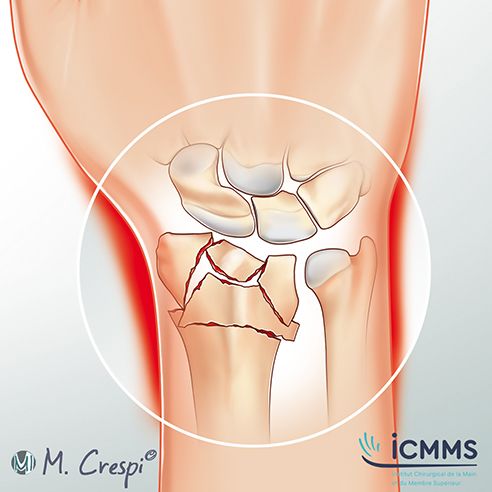
What is a distal radius fracture?
The radius and the ulna form the forearm. The lower end of the radius carries the joint surface on which the carpal bones (the small bones of the wrist) rest. It is one of the most common fractures in adults.
Two profiles are seen:
- the young person, after a violent injury (sport, road accident, fall from a height), often with a complex fracture that reaches the joint
- the person over 50, especially women after the menopause, in whom a simple fall from standing height is enough because of osteoporosis (bone fragility)
The old names (Pouteau-Colles fracture when the fragment tilts towards the back of the hand, Goyrand-Smith fracture when it tilts towards the palm) are still used, but treatment is based above all on a precise analysis of the displacement and of the joint involvement.
What are the symptoms?
- Severe wrist pain immediately after the fall
- Swelling (oedema) and bruising
- Deformity of the wrist, a "dinner fork" shape in the classic form
- Inability to use the hand
- Sometimes tingling in the fingers due to irritation of the median nerve, which should be reported quickly
How is it diagnosed?
Front and side X-rays confirm the fracture and measure its displacement. A CT scan is often requested to analyse fractures that reach the joint and to plan the operation. The doctor also checks for any associated injury: fracture of the ulna, fracture of the scaphoid (see scaphoid nonunion), ligament injury of the wrist bones (scapholunate ligament, TFCC).
After the age of 50, a wrist fracture after a minor fall should prompt a search for osteoporosis; tests (vitamin D level, bone density scan) are often offered together with your GP.
What are the non-surgical treatments?
A stable non-displaced fracture is treated by immobilisation:
- custom-made thermoplastic splint, usually for six weeks
- frequent follow-up X-rays during the first weeks, because a fracture can shift later despite immobilisation
- finger movement from the first day to prevent stiffness and swelling
In older people with low functional demands, some displacement can be accepted without an operation, after discussion.
When is surgery needed?
Surgery is offered when the fracture is displaced or unstable, or when it reaches the joint with a step in the cartilage. Letting a fracture heal in a poor position leads to pain, loss of strength, stiffness and, in the long term, to arthritis of the wrist.
How is the operation performed?
The surgeon puts the fragments back in place, then fixes them. Several techniques exist:
- pins (K-wires): thin metal rods inserted through the skin, suited to some simple fractures; immobilisation is then needed and the pins are removed in the operating theatre under local anaesthesia after a few weeks
- locking plate: placed on the palm side of the wrist, it provides a strong fixation that makes immobilisation unnecessary and allows you to use the hand for light tasks from the first days
- arthroscopic assistance: for some fractures involving the joint, a camera inserted into the wrist makes it possible to check the cartilage surface and look for an associated ligament injury
The operation is most often done as a day case, under regional anaesthesia of the arm: the arm stays numb for several hours, which ensures a comfortable night.
After the operation
- Keep your hand raised and move your fingers from the day of the operation
- With a plate, light tasks (writing, eating, using a computer) are usually allowed quickly; effort and carrying loads must wait until the bone has healed, at around six weeks
- Rehabilitation is needed to regain movement and strength
- The plate is most often removed
Possible complications are stiffness, irritation of a tendon by the implant, carpal tunnel syndrome or complex regional pain syndrome. They are explained to you at your consultation.
Frequently asked questions
Splint or operation: who decides?
The choice depends on the displacement, the stability and the joint involvement seen on the X-rays and CT scan, but also on your age, your dominant hand and your activities; it is discussed at your consultation.
When will I be able to drive after an operated wrist fracture?
You can drive again when you can grip the steering wheel firmly and react without pain, often after a few weeks with a plate; if you are treated with a splint, driving is not possible during immobilisation.
Does the plate need to be removed?
Most often, yes. The plate no longer has a role once the bone has healed; it can restrict movement or irritate the tendons.
Why am I being told about osteoporosis after a wrist fracture?
Because a wrist fracture after a minor fall is often the first sign of bone fragility; detecting it makes it possible to prevent other fractures, especially of the hip or the vertebrae.
Consultations in Lyon
Dr Maxime Cievet-Bonfils sees patients at:
- ICMMS – Centre Eiffel, 18-20 rue Tronchet, 69006 Lyon (3rd floor)
- Clinique de l'Infirmerie Protestante, 3 chemin du Penthod, 69300 Caluire-et-Cuire (Building D, 4th floor)
Secretary (direct line): +33 4 87 25 83 35 · Consultations in French or English.
This page provides general information. It does not replace a consultation: every situation is different.