TFCC tear (triangular ligament of the wrist)
The TFCC (triangular fibrocartilage complex) is a small "meniscus" of the wrist that stabilises the joint between the radius and the ulna, on the little-finger side. A tear, after a fall or through wear, causes pain on the inner (little-finger) side of the wrist, especially when turning the forearm. Treatment starts with rest and a splint; if the pain persists, wrist arthroscopy (keyhole surgery) makes it possible to clean up or repair the tear.
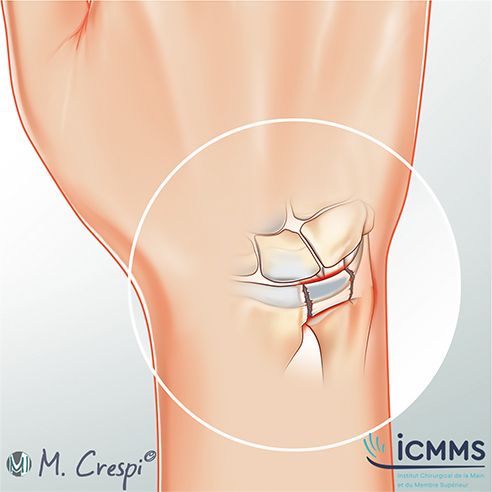
What is the TFCC?
The TFCC is a structure made up of a disc of fibrocartilage and ligaments, located between the head of the ulna (the forearm bone on the little-finger side) and the carpal bones. It has two roles:
- Cushioning the pressure transmitted from the hand to the forearm, on the ulnar (little-finger) side of the wrist
- Stabilising the distal radioulnar joint, which allows you to turn the palm up or down (pronation-supination)
There are two main types of tear:
- Traumatic tears, after a fall on the hand, a sudden twist or an impact (racket, golf club). They are sometimes associated with a wrist fracture.
- Degenerative tears, through gradual wear, often encouraged by an ulna that is slightly longer than the radius: this is then called ulnocarpal impaction.
What are the symptoms?
- Pain on the inner side of the wrist (little-finger side), brought on by turning movements: turning a key, using a screwdriver, carrying a saucepan, pushing up on the hand to get up
- A painful snap or clunk during certain movements
- Loss of strength for gripping or carrying
- A feeling of instability, sometimes an abnormal prominence of the head of the ulna on the back of the wrist
How is it diagnosed?
The clinical examination looks for pain at a precise point on the ulnar side of the wrist and tests the stability of the distal radioulnar joint, comparing it with the other side.
- X-rays: they rule out a fracture and measure the length of the ulna relative to the radius.
- CT arthrogram (CT scan after injection of contrast dye into the joint): it shows the TFCC tear and any associated injuries of the ligaments or cartilage.
Arthroscopy remains the most precise test: it confirms the tear and allows it to be treated at the same time.
What are the non-surgical treatments?
Very recent traumatic TFCC tears can sometimes be treated simply with a custom-made thermoplastic splint that blocks pronation-supination.
Partial tears can sometimes recover after well-conducted rehabilitation.
When is surgery needed?
Surgery is considered when the pain persists after several months of properly conducted treatment for a partial tear, or straight away in the case of clear instability of the distal radioulnar joint with a complete tear. The choice of procedure depends on the location of the tear, how long ago it happened and any associated ulnocarpal impaction.
How is the operation performed?
The operation is done by wrist arthroscopy: a small camera and fine instruments are inserted through incisions of a few millimetres. It is done as a day case, under regional anaesthesia (anaesthesia of the arm).
Depending on the tear:
- Debridement: a central tear, in an area with a poor blood supply that does not heal, is trimmed to remove the fragment that rubs.
- Reattachment (suture): a tear at the edge, where the tissue has a good blood supply, is stitched back in place, by arthroscopy or through a short additional incision.
- Associated procedure: if the ulna is too long, an ulnar shortening can be performed at the same time.
After the operation
- After a simple debridement, immobilisation is short and everyday activities are resumed within a few weeks.
- After a reattachment, the wrist and forearm are immobilised for 4 weeks to block turning movements and allow the repair to heal, then rehabilitation is prescribed.
- Return to sports that put strain on the wrist and to heavy manual work is gradual, usually after several months.
Complications are rare: stiffness, irritation of a small sensory nerve branch, complex regional pain syndrome. They are explained to you at your consultation.
Frequently asked questions
Can a TFCC tear heal on its own?
Yes, sometimes. Tears at the edge, which have a better blood supply, can heal with immobilisation, and many tears become only mildly bothersome with rest and rehabilitation.
Does a TFCC tear seen on an MRI scan always need an operation?
No. Degenerative tears are common without any pain, especially after the age of 40. We treat a patient who has pain and whose examination matches the tear, not an isolated image.
Will I be able to play tennis or golf again?
Most often, yes, after a gradual, supervised return. The timing depends on the procedure performed and is longer after a reattachment than after a debridement.
Does wrist arthroscopy leave scars?
The incisions measure a few millimetres and usually become very discreet after a few months.
Consultations in Lyon
Dr Maxime Cievet-Bonfils sees patients at:
- ICMMS – Centre Eiffel, 18-20 rue Tronchet, 69006 Lyon (3rd floor)
- Clinique de l'Infirmerie Protestante, 3 chemin du Penthod, 69300 Caluire-et-Cuire (Building D, 4th floor)
Secretary (direct line): +33 4 87 25 83 35 · Consultations in French or English.
This page provides general information. It does not replace a consultation: every situation is different.