Carpal boss
A carpal boss is a small, hard bony prominence on the back of the hand, at the base of the index and middle fingers, just in front of the wrist. It corresponds to a small area of localised arthritis between the carpal bones and the base of the metacarpals, and can be painful when putting weight on the hand or during movement. Treatment is first non-surgical; if the discomfort persists, the lump can be removed during a short operation done as a day case.
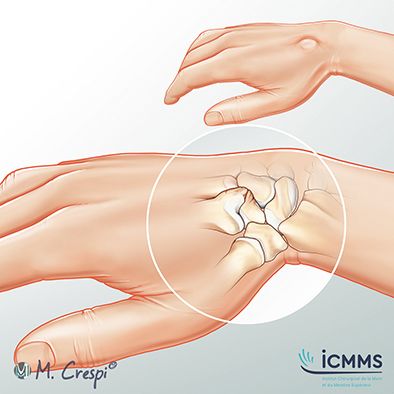
What is a carpal boss?
A carpal boss is a bony outgrowth located at the junction between the base of the second and third metacarpals (the bones of the palm in line with the index and middle fingers) and the carpal bones just behind them, the trapezoid and the capitate.
It is most often made up of osteophytes (bony spurs) linked to very localised arthritis of this small joint, which moves very little. More rarely, it is a small extra bone, present from birth. Repeated strain on the wrist or an injury can bring it to light.
It should not be confused with a wrist ganglion, which is soft or tense, whereas a carpal boss is hard and fixed. The two are sometimes found together.
What are the symptoms?
- A hard, fixed lump on the back of the hand, more visible with the wrist bent
- Pain when pressure is applied directly or when the wrist is forcibly bent back (press-ups, carrying loads)
- Concern about its appearance
- Sometimes a clicking or rubbing of an extensor tendon that slides over the lump
How is it diagnosed?
The clinical examination finds a hard bony prominence, painful when pressed, at the base of the second and third metacarpals. X-rays with a suitable side view show the prominence. A CT scan shows its shape and the condition of the joint in detail. An ultrasound scan looks for an associated cyst or tendon irritation.
What are the non-surgical treatments?
Many carpal bosses cause little trouble and need no treatment. If there is pain:
- Temporarily avoid weight-bearing on the hand and the movements that trigger it
- A wrist splint during demanding activities
- Anti-inflammatory medication for short periods
When is surgery needed?
Surgery is offered when the pain persists despite these measures and interferes with your work, sport or daily life. Concern about appearance alone is discussed on a case-by-case basis.
How is the operation performed?
Through a short incision on the back of the hand, moving the extensor tendons aside, the surgeon removes the bony prominence (excision) until a smooth surface is restored, together with any associated cyst.
The operation is done as a day case. It is performed under regional anaesthesia of the arm.
After the operation
- A dressing is kept on for about two weeks
- Immobilisation is worn for 4 weeks
- The fingers are moved immediately for light tasks
- Return to putting weight on the hand and to effort is gradual over a few weeks
- Rehabilitation is sometimes useful in the case of stiffness
Complications are rare: haematoma, infection, tender scar, stiffness, complex regional pain syndrome. Regrowth of the bone or persistent pain linked to the underlying arthritis remain possible.
Frequently asked questions
Is a carpal boss serious?
No. It is a benign condition that does not threaten the wrist. It is only treated if it causes trouble.
Can a carpal boss go away on its own?
No, the bony lump does not disappear. However, the pain can ease with time and with non-surgical treatment.
Can I return to sport after the operation?
Yes, usually, after a gradual return. Sports that involve putting weight on the hands are resumed last, once the scar and the wrist are no longer painful.
Can the lump come back?
It is possible but uncommon. A sufficiently complete excision limits this risk.
Consultations in Lyon
Dr Maxime Cievet-Bonfils sees patients at:
- ICMMS – Centre Eiffel, 18-20 rue Tronchet, 69006 Lyon (3rd floor)
- Clinique de l'Infirmerie Protestante, 3 chemin du Penthod, 69300 Caluire-et-Cuire (Building D, 4th floor)
Secretary (direct line): +33 4 87 25 83 35 · Consultations in French or English.
This page provides general information. It does not replace a consultation: every situation is different.