Ulnocarpal impaction
Ulnocarpal impaction is excessive rubbing between the head of the ulna and the carpal bones, when the ulna is too long compared with the radius. It causes pain on the inner side of the wrist (the little-finger side), made worse by turning movements and gripping. If non-surgical treatment fails, the operation consists of shortening the ulna or trimming its end by arthroscopy (keyhole surgery).
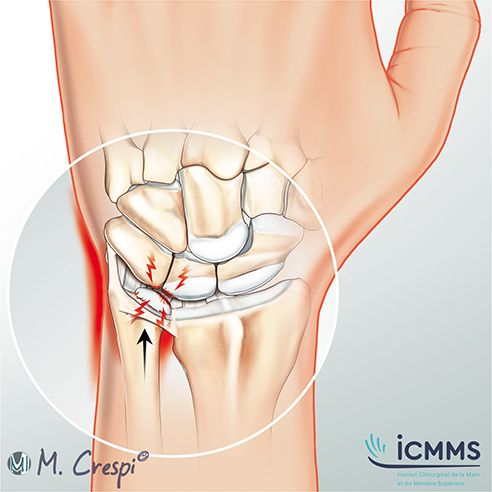
What is ulnocarpal impaction?
The forearm has two bones: the radius, on the thumb side, and the ulna, on the little-finger side. Normally, the end of the ulna lies at roughly the same level as the end of the radius. Between the ulna and the carpus lies a shock absorber, the TFCC (triangular fibrocartilage complex).
When the ulna is longer than the radius (this is called "positive ulnar variance"), it transmits an excessive share of the pressure to the carpus. Over time, the TFCC thins and then develops a hole (perforation), the cartilage of the lunate and of the head of the ulna wears, and the ligament between the lunate and the triquetrum can tear.
This overly long ulna can be:
- Constitutional, present from the start
- Acquired, most often after a wrist fracture that shortened the radius as it healed
Impaction can also occur with an ulna of normal length, with repeated effort involving rotation and gripping.
What are the symptoms?
- Pain on the inner side of the wrist, coming on gradually
- Pain made worse by turning the forearm (turning a key or a door handle, using a screwdriver) and by tilting the wrist towards the little finger
- Loss of grip strength
- Cracking, sometimes a feeling of locking
- Swelling on the inner side of the wrist after effort
How is it diagnosed?
The clinical examination looks for pain when pressing on the ulnar side of the wrist and reproduces it with manoeuvres that press the ulna against the carpus.
- Front-view X-rays of both wrists, taken in a standardised position: they measure the length of the ulna relative to the radius and compare it with the healthy side. A view with the fist clenched can accentuate the impaction.
- MRI scan: it shows bone oedema (inflammation of the bone), typically at the edge of the lunate and of the head of the ulna, and the condition of the TFCC.
- CT arthrogram: it reveals a perforation of the TFCC or of the lunotriquetral ligament, and wear of the cartilage.
What are the non-surgical treatments?
- A wrist splint during painful periods
- Avoiding the movements that trigger it: forceful rotation, certain racket or striking sports
- Anti-inflammatory medication for short periods
- Corticosteroid injection into the wrist joint
These measures often bring relief, but do not correct the length of the ulna.
When is surgery needed?
Surgery is offered when the pain persists after several months of properly conducted treatment and interferes with your work, sport or daily life. The choice of technique depends on how much too long the ulna is and on the condition of the joint between the radius and the ulna.
How is the operation performed?
The operation is done under regional anaesthesia (anaesthesia of the arm), most often as a day case.
- Ulnar shortening osteotomy: through an incision on the inner side of the forearm, the ulna is cut, shortened by a few millimetres and then fixed with a plate and screws. This is the procedure most often offered; it also tightens the ligaments on the ulnar side of the wrist.
- Arthroscopic resection of the end of the ulna (wafer procedure): by wrist arthroscopy, through small incisions, the surgeon removes a thin slice of the head of the ulna through the perforation in the TFCC. It is suited to moderate excess length.
Arthroscopy also makes it possible, at the same time, to trim the damaged TFCC and cartilage.
After the operation
- After an osteotomy, a short period of resting immobilisation is followed by rehabilitation; bone healing often takes more than three months
- After an arthroscopic resection, return to everyday tasks is quicker
- Return to heavy manual work and to sports that put strain on the wrist is gradual, over several months
- The plate can be removed later if it becomes bothersome
Possible complications (delayed bone healing, discomfort from the plate, stiffness, complex regional pain syndrome) are explained to you at your consultation.
Frequently asked questions
Why is my ulna too long?
Either it is the way you have always been built, or the radius has shortened after a wrist fracture. In both cases, comparative X-rays of both wrists make it possible to measure it.
Can ulnocarpal impaction damage the wrist?
Yes, if it goes on for a long time: the TFCC develops a hole and the cartilage wears. That is why persistent pain on the inner side of the wrist deserves to be investigated.
Does the plate need to be removed after the osteotomy?
Not routinely. It is removed if it is bothersome, once the bone has fully healed, usually after at least a year.
How is it different from a TFCC tear?
Ulnocarpal impaction is one cause of wear of the TFCC. A TFCC tear can also be traumatic, without an overly long ulna; the treatment is then different.
Consultations in Lyon
Dr Maxime Cievet-Bonfils sees patients at:
- ICMMS – Centre Eiffel, 18-20 rue Tronchet, 69006 Lyon (3rd floor)
- Clinique de l'Infirmerie Protestante, 3 chemin du Penthod, 69300 Caluire-et-Cuire (Building D, 4th floor)
Secretary (direct line): +33 4 87 25 83 35 · Consultations in French or English.
This page provides general information. It does not replace a consultation: every situation is different.