Wrist arthritis
Wrist arthritis (osteoarthritis) is wear of the cartilage in the wrist joints, most often the result of an old ligament injury or of a fracture that healed in a poor position. It causes pain on effort, stiffness and loss of strength. Treatment starts with a splint and injections; if the discomfort persists, several operations are possible: denervation, partial fusion (arthrodesis), removal of the first row of carpal bones (proximal row carpectomy) or wrist replacement.
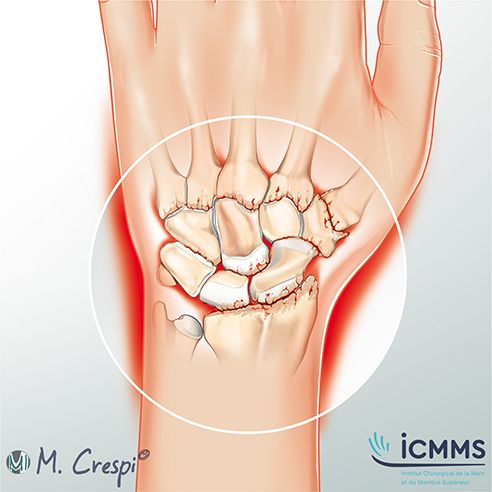
What is wrist arthritis?
The wrist is made up of the end of the radius and eight small bones, the carpal bones, arranged in two rows. Their surfaces are covered with cartilage. When this cartilage wears away, the bones rub directly against each other.
Unlike the hip or the knee, wrist arthritis is rarely due to ageing alone. It most often follows:
- An old tear of the scapholunate ligament: the scaphoid and the lunate come apart, which leads to gradual wear (known as "SLAC" arthritis). See scapholunate ligament injury.
- A scaphoid fracture that has not healed (known as "SNAC" arthritis). See scaphoid nonunion.
- A fracture of the radius that involved the joint surface or healed with a step. See wrist fracture.
- Advanced Kienböck's disease, inflammatory rheumatic diseases or repeated minor injuries.
Arthritis at the base of the thumb is a different condition: thumb base arthritis.
What are the symptoms?
- Wrist pain on effort, when putting weight on the hand (getting up from a chair), when carrying a load
- Stiffness, with a gradual loss of the ability to bend and straighten the wrist
- Swelling of the wrist after effort
- Cracking or a grinding sensation
- Reduced grip strength
It progresses over years. Some arthritis that is visible on X-rays remains only mildly painful for a long time.
How is it diagnosed?
The clinical examination measures movement and strength and locates the pain. X-rays of both wrists show narrowing of the joint space, osteophytes (bony spurs) and the cause of the arthritis. A CT scan or a CT arthrogram shows the extent of the wear and, above all, the areas of cartilage that remain healthy: this is what guides the choice of operation.
What are the non-surgical treatments?
- A wrist splint worn during painful activities or at night
- Painkillers and anti-inflammatory medication during flare-ups
- Corticosteroid injection into the joint, whose effect is often temporary
- Adapting how you use your hand and, if needed, your workstation, with the help of a hand therapist (physiotherapist)
When is surgery needed?
Surgery is offered when the pain persists despite medical treatment and affects your work, sport or daily life. The choice depends on where the wear is, your age, your activities and how much movement you wish to keep.
How is the operation performed?
The operations are done under regional anaesthesia (anaesthesia of the arm), most often as a day case.
- Wrist denervation: cutting small sensory nerve branches that carry pain from the joint. This simple procedure preserves movement; it reduces pain without stopping the wear and can be offered alone or combined with another procedure.
- Partial fusion (partial arthrodesis): fusing a few carpal bones together, the worn areas being removed. The wrist keeps part of its movement and becomes less painful and stronger. A common example is the so-called "four-corner" fusion.
- Proximal row carpectomy: removal of the scaphoid, the lunate and the triquetrum; the capitate then comes to articulate with the radius. This procedure preserves part of the movement, provided the cartilage of these two surfaces is in good condition.
- Wrist replacement (wrist prosthesis): replacing the worn joint surfaces with implants. It aims to relieve pain while preserving movement, in selected patients whose activities do not put heavy strain on the wrist.
- Total fusion (total arthrodesis): complete fusion of the wrist. It removes the ability to bend and straighten the wrist but preserves rotation of the forearm; it is reserved for extensive arthritis or when other treatments have failed.
Some procedures can be performed or prepared by wrist arthroscopy (keyhole surgery).
After the operation
- After a denervation, return to everyday tasks is quick
- After a partial fusion, immobilisation for several weeks is needed until the bones have fused
- After a proximal row carpectomy or a wrist replacement, rehabilitation is prescribed to regain movement
- Full recovery usually takes several months
Possible complications (infection, stiffness, failure of the bones to fuse, wear or loosening of a wrist replacement, complex regional pain syndrome) are explained to you at your consultation.
Frequently asked questions
Does wrist arthritis always get worse?
It usually progresses slowly, over years, and the pace varies greatly from one person to another. Treatment depends on how much it bothers you, not only on how the X-ray looks.
Can a wrist be replaced like a hip?
Yes, wrist replacements exist and allow movement to be preserved. They are not suitable for everyone: heavy manual work and carrying heavy loads put too much strain on them. Whether one is appropriate is discussed on a case-by-case basis.
What do you lose with a partial fusion?
Part of the wrist's movement, which varies depending on the bones fused. Most everyday tasks remain possible and rotation of the forearm is preserved.
Is denervation enough?
It can give lasting relief to some patients, with a straightforward recovery. It does not correct the wear: if the pain comes back, another operation is still possible.
Consultations in Lyon
Dr Maxime Cievet-Bonfils sees patients at:
- ICMMS – Centre Eiffel, 18-20 rue Tronchet, 69006 Lyon (3rd floor)
- Clinique de l'Infirmerie Protestante, 3 chemin du Penthod, 69300 Caluire-et-Cuire (Building D, 4th floor)
Secretary (direct line): +33 4 87 25 83 35 · Consultations in French or English.
This page provides general information. It does not replace a consultation: every situation is different.