Thumb base arthritis (basal joint osteoarthritis)
Thumb base arthritis (rhizarthrosis) is osteoarthritis of the joint at the base of the thumb, between the trapezium and the first metacarpal. It causes pain when pinching and gripping. In the early stages, treatment starts with a splint and injections; if these fail or the disease is more advanced, a trapeziometacarpal prosthesis (joint replacement) may be offered.
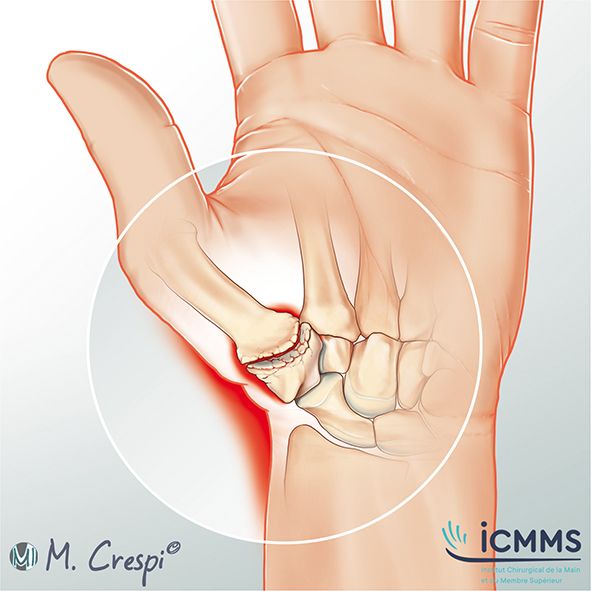
What are the symptoms?
- Pain at the base of the thumb, at the level of the wrist
- Pain when opening a jar, turning a key, writing or pinching
- Loss of pinch strength
- In advanced stages: deformity of the base of the thumb, stiffness
How is it diagnosed?
The clinical examination points to the diagnosis; X-rays of the thumb confirm the osteoarthritis and show its stage.
What are the non-surgical treatments?
- A resting splint worn at night or during painful activities
- An injection of PRP (platelet-rich plasma) or corticosteroids into the joint
When is surgery needed?
Surgery is offered when pain persists despite well-conducted medical treatment and affects daily or working life. The choice of technique depends on your age, your activities, the stage of the osteoarthritis and the condition of the neighbouring joints.
The trapeziometacarpal prosthesis
The prosthesis replaces the worn joint with an artificial joint: one component fixed in the trapezium, a stem in the first metacarpal. It aims to relieve pain while preserving the length and strength of the thumb.
Current prostheses, particularly dual-mobility designs, have a survival rate of about 90% at 10 years in published series (Chammas et al., OTSR 2026; Toffoli et al., J Hand Surg Am 2024).
The operation is done as a day case, under regional anaesthesia of the arm. The thumb is immobilised for 3 weeks, after which rehabilitation is needed. Full recovery of strength takes several months.
Dr Cievet-Bonfils co-authored a study on the 31-year outcome of a series of trapeziometacarpal prostheses (see below).
Frequently asked questions
Does a thumb prosthesis last a lifetime?
Not always: a prosthesis can wear or loosen over time. With current models, about 9 prostheses out of 10 are still in place 10 years after the operation. If it fails, revision surgery is still possible.
Can both thumbs be operated on?
Yes, usually several months apart.
How long before I can drive?
This depends on the immobilisation and on your recovery; it is discussed case by case, often after 3 weeks.
Consultations in Lyon
Dr Maxime Cievet-Bonfils sees patients at:
- ICMMS – Centre Eiffel, 18-20 rue Tronchet, 69006 Lyon (3rd floor)
- Clinique de l'Infirmerie Protestante, 3 chemin du Penthod, 69300 Caluire-et-Cuire (Building D, 4th floor)
Secretary (direct line): +33 4 87 25 83 35 · Consultations in French or English.
This page provides general information. It does not replace a consultation: every situation is different.