Finger and metacarpal fractures
A finger or metacarpal fracture is a break in a phalanx (a finger bone) or a metacarpal (a long bone of the palm). It causes pain, swelling and sometimes a deformity or a finger that overlaps its neighbour when you make a fist. A stable fracture is treated with a splint; a displaced, rotated or joint fracture is most often fixed surgically.
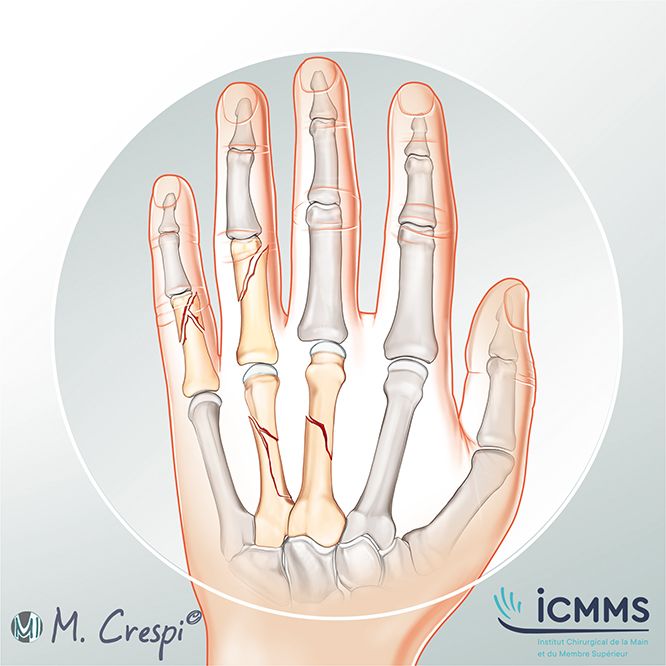
What is a finger or metacarpal fracture?
The hand has five metacarpals and fourteen phalanges: three in each finger and two in the thumb. These bones break from a direct blow (a punch, a crush injury, a ball), a fall or a twisting of the finger. A fracture of the neck of the fifth metacarpal after a punch is one of the most common ("boxer's fracture").
Several situations are distinguished, and they guide treatment:
- undisplaced, stable fracture: the fragments stay in place
- displaced fracture: the fragments are shifted, angled or shortened
- rotated fracture: the finger twists on itself and crosses over the neighbouring finger when bending
- joint fracture: the fracture line runs into a joint, with a risk of stiffness and osteoarthritis
What are the symptoms?
- Sharp localised pain after the injury, sometimes with a crack felt
- Swelling (oedema) and bruising of the finger or the back of the hand
- Visible deformity, shortening or a knuckle that has lost its "bump" on the back of the hand
- A finger that overlaps its neighbour when you make a fist, a sign of rotation
- Difficulty bending or straightening the finger
How is it diagnosed?
The clinical examination looks above all for a rotation problem: you are asked to close your fist gently to check that all the nails point to the same place. Front and side X-rays confirm the fracture and measure how far it is displaced. A CT scan is sometimes requested for complex joint fractures. If there is an associated wound, the fracture is called open and needs emergency treatment (see hand emergencies).
What are the non-surgical treatments?
Undisplaced, stable fractures are treated without an operation:
- a splint, or a custom-made thermoplastic splint, leaving the uninvolved joints free, or buddy strapping (the injured finger is attached to its neighbour with strapping)
- immobilisation for a few weeks, usually 3 to 6 depending on the bone and the type of fracture
- frequent follow-up X-rays in the first weeks, to check that the fracture does not shift
- painkillers and elevation of the hand to limit swelling
Fingers do not tolerate prolonged immobilisation well: movement is resumed as soon as stability allows, often with the help of a hand therapist (physiotherapist).
When is surgery needed?
Surgery is offered when the fracture is:
- displaced or angled beyond what the hand can tolerate
- rotated (overlapping finger), because rotation cannot be corrected with a splint
- into the joint with a step in the cartilage surface
- unstable, meaning it shifts again inside the splint
- open or associated with an injury to a tendon, nerve or blood vessel
Timing matters: a fracture that heals in a poor position (malunion) is harder to correct later. It is better to see a hand surgeon within the first few days.
How is the operation performed?
The surgeon puts the fragments back in place (reduction), then holds them (internal fixation) with hardware suited to the fracture:
- pins (K-wires): thin metal rods inserted through the skin, often without opening, removed after a few weeks
- screws alone, for some oblique or joint fractures
- a plate and screws, when the fixation needs to be strong enough to allow early movement
The operation is done as a day case, under regional anaesthesia of the arm.
After the operation
- A protective splint is often worn for a few weeks, leaving free the joints that can be left free
- Rehabilitation starts early to limit stiffness, the main risk of hand fractures
- The pins (K-wires) are removed in the operating theatre under local anaesthesia, usually around the fourth to sixth week; screws and plates are most often left in place unless they cause discomfort
- Return to work and sport depends on the bone, the fixation and your activity
Possible complications are stiffness, malunion, delayed healing, infection or complex regional pain syndrome. They are explained to you at the consultation.
Frequently asked questions
Can a small deformity remain after a boxer's fracture?
Yes, a slight tilt of the neck of the fifth metacarpal is often well tolerated and can be treated without surgery; the loss of the knuckle's "bump" is then mainly cosmetic, but a rotation must always be corrected.
How long does a broken finger take to heal?
The bone is usually strong enough for everyday use after four to six weeks, but complete healing takes at least 3 months; suppleness and strength continue to improve for several months.
Is a plaster cast always needed?
No. Custom-made splints and buddy strapping have largely replaced plaster casts for fingers: they immobilise only what is necessary and limit stiffness.
Why is my finger still swollen and stiff after the fracture has healed?
Swelling often persists for several weeks, or even a few months; rehabilitation, regular exercises and sometimes a corrective (positioning) splint help to recover movement.
Consultations in Lyon
Dr Maxime Cievet-Bonfils sees patients at:
- ICMMS – Centre Eiffel, 18-20 rue Tronchet, 69006 Lyon (3rd floor)
- Clinique de l'Infirmerie Protestante, 3 chemin du Penthod, 69300 Caluire-et-Cuire (Building D, 4th floor)
Secretary (direct line): +33 4 87 25 83 35 · Consultations in French or English.
This page provides general information. It does not replace a consultation: every situation is different.