Finger sprains
A finger sprain is an injury to the ligaments of the middle joint of the finger (proximal interphalangeal joint), most often after being hit by a ball or a fall. It causes pain, swelling and stiffness that can last several months. Most sprains are treated without surgery, by strapping the finger to the neighbouring finger and moving it early; surgery is reserved for unstable dislocations and certain fractures.
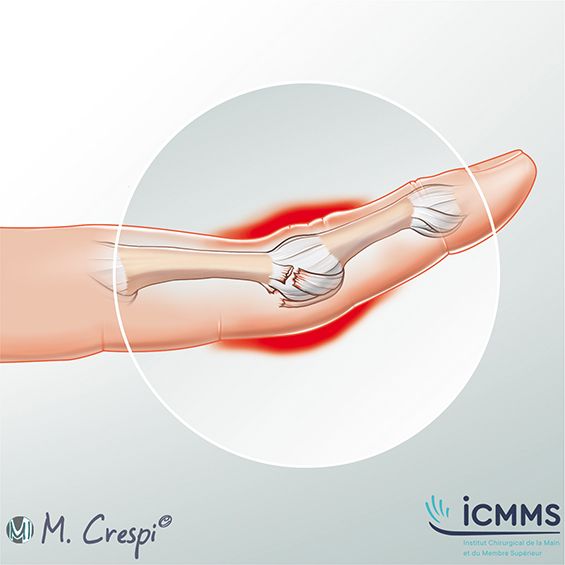
What is a finger sprain?
The middle joint of the finger, between the first and second phalanges (finger bones), is stabilised by two side ligaments (the collateral ligaments) and by a thick structure on its palm side, the volar plate. A sprain is a stretching (mild sprain) or a tear (severe sprain) of one of these structures.
The most common mechanism is a finger bent backwards by a ball, which injures the volar plate, sometimes with a small fragment of bone pulled off the base of the second phalanx. A sideways impact tends to injure a collateral ligament. In the most severe cases, the joint comes out of place (dislocation). These sprains are common in ball sports (volleyball, basketball, handball), climbing and manual work.
What are the symptoms?
- Pain in the middle joint of the finger, worse with pressure and movement
- Rapid swelling, which gives the finger a "spindle" shape
- Bruising in the following days
- Difficulty bending or fully straightening the finger
- Visible deformity in the case of a dislocation, and a feeling that the finger is unstable and "gives way" in the case of a complete ligament rupture
A finger that can no longer be straightened actively at the middle joint may indicate an injury to the extensor tendon, which must be recognised quickly to avoid a permanent deformity ("boutonnière" finger).
How is it diagnosed?
The surgeon locates the pain, tests the stability of the joint and checks that the tendons are working. Front and side X-rays of the finger are always taken: they look for a fracture or a fragment of bone pulled off and check that the joint is properly centred. An ultrasound scan helps to assess damage to the ligaments, the volar plate or the tendons; an MRI is rarely needed.
A dislocation that has been put back in place at the scene must still be examined and X-rayed. An emergency consultation allows prompt treatment.
What are the non-surgical treatments?
The great majority of finger sprains are treated without an operation:
- Buddy strapping: the injured finger is attached to the neighbouring finger with a suitable strap, which protects it while allowing it to move; it is usually worn for 3 to 4 weeks
- Sometimes a splint for a short period for certain injuries, particularly a small bony avulsion (a fragment of bone pulled off) or instability
- Ice, elevation of the hand and painkillers in the first few days
- Early movement and rehabilitation: this is the most important point, because prolonged immobilisation of this joint easily leads to lasting stiffness
When is surgery needed?
Surgery is needed in less common situations:
- a dislocation that cannot be put back in place (irreducible) or that keeps recurring (unstable)
- a large or displaced fracture into the joint at the base of the second phalanx (see finger and metacarpal fractures)
- a complete ligament rupture with persistent instability
How is the operation performed?
Depending on the injury, the surgeon puts the joint back in place, repairs the torn ligament or reattaches it to the bone (for example with a small anchor), or fixes the bone fragment with pins (K-wires), a screw or a small plate. The aim is a stable joint that allows early rehabilitation. The operation is done as a day case, under regional anaesthesia of the arm.
After the operation
- A splint protects the joint while it heals, usually for a few weeks
- Rehabilitation with a hand therapist (physiotherapist) starts early to limit stiffness
- Return to sport is gradual, often with protective buddy strapping
Whether or not there has been surgery, it is usual for the joint to remain somewhat swollen and stiff for several months. Permanent thickening of the joint is common and generally has no effect on function.
Frequently asked questions
How long does the swelling last after a finger sprain?
Often several months. The joint may stay a little thicker than the same joint on the other hand, which does not prevent good function.
Should a sprained finger be immobilised in a splint?
Rarely strictly and for a long time. Most often, buddy strapping to the neighbouring finger allows movement while protecting the joint, which limits stiffness.
When can I go back to sport?
It depends on how severe the sprain is and on the sport. It is often possible within a few weeks, with the finger strapped to its neighbour for the first sessions.
My finger dislocated and then went back into place: should I see a doctor?
Yes. An X-ray is needed to look for an associated fracture and check that the joint is properly centred and stable.
Consultations in Lyon
Dr Maxime Cievet-Bonfils sees patients at:
- ICMMS – Centre Eiffel, 18-20 rue Tronchet, 69006 Lyon (3rd floor)
- Clinique de l'Infirmerie Protestante, 3 chemin du Penthod, 69300 Caluire-et-Cuire (Building D, 4th floor)
Secretary (direct line): +33 4 87 25 83 35 · Consultations in French or English.
This page provides general information. It does not replace a consultation: every situation is different.