Dupuytren's disease
Dupuytren's disease is a progressive thickening of the fibrous tissue of the palm (the palmar fascia). It forms nodules, then cords that gradually pull the fingers into the palm, mostly the ring and little fingers. It is treated when the contracture becomes a nuisance: there is no preventive treatment.
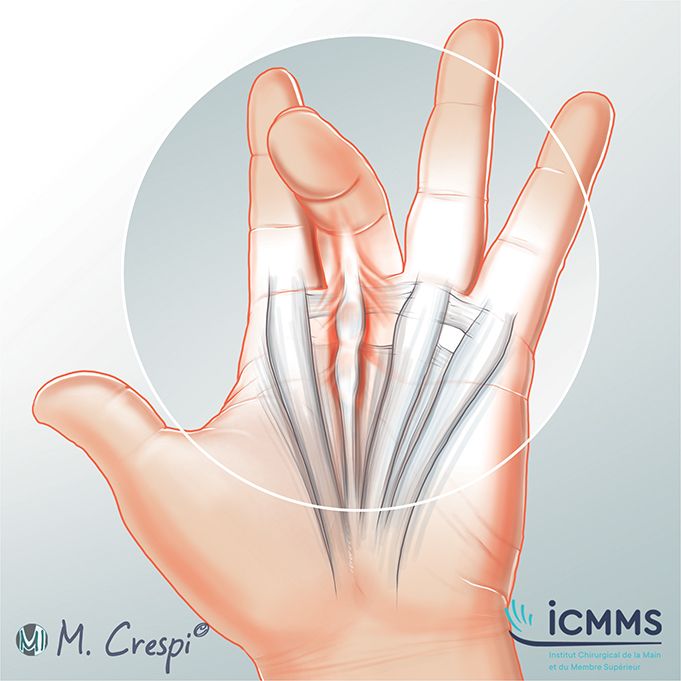
What is Dupuytren's disease?
It is a benign condition, often running in families, more common in men over 50. It is not caused by manual work. It progresses slowly, in flare-ups, and can affect both hands.
What are the signs?
- A firm nodule in the palm, sometimes tender at first
- A cord under the skin, running from the nodule towards the finger
- Progressive bending of the finger, which can no longer be fully straightened
- Difficulty laying the hand flat, putting on gloves or shaking hands
When is surgery needed?
A nodule alone, without contracture, does not need treatment. Treatment is offered when the hand can no longer be laid flat on a table, when the contracture is progressing, or earlier when the middle joint of the finger is involved, because it recovers less well if treatment is delayed.
What are the treatments?
Treatment depends on the stage, the number of fingers involved and your expectations:
- Percutaneous needle fasciotomy: the cord is divided through the skin with a needle, under local anaesthesia, in a minimally invasive way. However, the disease gradually recurs, after a median of 3 years.
- Fasciectomy: surgical removal of the cords through one or more incisions. It lasts longer and suits extensive forms.
- In recurrent or very severe forms, other procedures (skin graft, joint fusion) may be discussed.
Procedures are performed as a day case, under regional anaesthesia.
After the operation
- Dressings for 2 to 3 weeks
- An extension splint worn at night for several weeks
- Rehabilitation with a hand therapist (physiotherapist)
Dupuytren's disease can recur or appear in other fingers over the years: surgery corrects the contracture, it does not cure the disease.
Frequently asked questions
Is Dupuytren's disease hereditary?
A family predisposition is common. Other factors (diabetes, smoking, alcohol) are associated with it.
Should I have surgery as soon as a nodule appears?
No. An isolated nodule is simply monitored. Surgery is discussed when a finger starts to bend.
Can the disease come back after surgery?
Yes, it can, particularly in younger patients or in extensive forms. The risk also depends on the technique chosen.
Consultations in Lyon
Dr Maxime Cievet-Bonfils sees patients at:
- ICMMS – Centre Eiffel, 18-20 rue Tronchet, 69006 Lyon (3rd floor)
- Clinique de l'Infirmerie Protestante, 3 chemin du Penthod, 69300 Caluire-et-Cuire (Building D, 4th floor)
Secretary (direct line): +33 4 87 25 83 35 · Consultations in French or English.
This page provides general information. It does not replace a consultation: every situation is different.