Mallet finger
Mallet finger is the loss of the ability to straighten the fingertip after a knock: the last phalanx (finger bone) stays bent and can no longer be straightened actively. It is caused by the extensor tendon tearing away from its attachment, sometimes with a small fragment of bone. Treatment is most often a splint worn continuously for 8 weeks; surgery is reserved for certain fractures and long-standing cases.
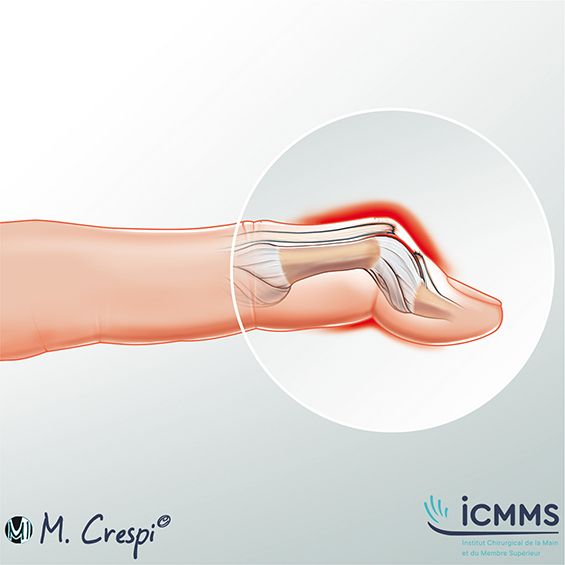
What is mallet finger?
The extensor tendon, on the back of the finger, ends at the base of the last phalanx. It is the tendon that straightens the fingertip. When the tip of the straight finger is struck (a ball, a door, an awkward movement while making a bed), the finger is forced into a bent position and the tendon ruptures or pulls off a fragment of bone from the phalanx. The fingertip then drops into a bent position, like the head of a mallet.
The injury often seems trivial. There are two types:
- tendon mallet finger, where only the tendon is ruptured
- bony mallet finger, where the tendon pulls off a fragment from the base of the last phalanx
What are the symptoms?
- A bent fingertip that cannot be straightened actively, although it can be straightened with the other hand
- Pain that is often moderate, or even absent when only the tendon is ruptured
- Swelling and bruising on the back of the last joint, more marked when there is a fracture
- Over time, without treatment, the middle joint of the finger can bend backwards too far (hyperextension), a deformity known as "swan neck"
How is it diagnosed?
The clinical examination is enough to recognise mallet finger. A side-view (lateral) X-ray of the finger is essential: it looks for a bone fragment, measures its size and checks that the last phalanx remains properly centred on the joint. These findings guide the choice between a splint and surgery. Ultrasound is rarely needed.
Seek medical advice promptly after the injury: treatment is simpler and more effective when it starts early. If in doubt, it is better to be seen quickly.
What are the non-surgical treatments?
The great majority of mallet fingers, whether tendon injuries or with a small undisplaced bone fragment, heal with a splint:
- the splint holds the last phalanx straight, leaving the middle joint of the finger free
- it is worn continuously, day and night, for 8 weeks
- it must never be removed during this period, even for washing: the slightest bending of the fingertip can disrupt healing and mean starting the treatment again
- to change it or clean the skin, keep the finger flat on a table, with the fingertip straight
- at the end of this period, the splint is often still worn at night for a few more weeks, with gradual weaning
Splint treatment can still be tried when the diagnosis is made a few weeks late.
When is surgery needed?
Surgery is offered in a limited number of situations:
- a large bone fragment, or a last phalanx that slips towards the palm (subluxation)
- failure of splint treatment
- a troublesome long-standing case, particularly with a swan-neck deformity
- inability to wear a splint continuously, for example in certain occupations
How is the operation performed?
In the case of a fracture, the bone fragment is put back in place and held with pins (K-wires) or a small plate and screws. In long-standing cases, the tendon can be tightened or reattached, or the joint fused (arthrodesis) if it is damaged. The operation is done as a day case, under anaesthesia of the finger or the arm.
After the operation
- The finger is protected by a splint while it heals, usually for about 6 weeks
- The pins (K-wires) are removed in the operating theatre, under local anaesthesia, once the bone has healed
- Rehabilitation may be prescribed to recover bending of the fingertip
After treatment, with or without surgery, a slight lack of straightening of the fingertip may remain; it is usually not very troublesome. Possible complications (pin-site infection, stiffness, damage to the skin or nail) are explained to you at the consultation.
Frequently asked questions
Does it matter if I do not treat my mallet finger?
Without treatment, the fingertip stays drooping and a swan-neck deformity may develop. Early treatment with a splint usually gives a better result.
Can I remove the splint to wash?
No, unless you keep the finger flat and straight on a surface. Any bending of the fingertip during the healing period can compromise the treatment.
Can I work with the splint?
Usually yes, if your work does not expose the finger to water or repeated knocks. Time off work depends on your job and on which finger is affected.
Does a bone fragment always need surgery?
No. Most small undisplaced fragments heal with a splint. Surgery is reserved for large fragments or when the joint is no longer centred.
Consultations in Lyon
Dr Maxime Cievet-Bonfils sees patients at:
- ICMMS – Centre Eiffel, 18-20 rue Tronchet, 69006 Lyon (3rd floor)
- Clinique de l'Infirmerie Protestante, 3 chemin du Penthod, 69300 Caluire-et-Cuire (Building D, 4th floor)
Secretary (direct line): +33 4 87 25 83 35 · Consultations in French or English.
This page provides general information. It does not replace a consultation: every situation is different.