Trigger finger
Trigger finger is a catching of the flexor tendon at the base of the finger. The finger locks in a bent position and then suddenly snaps free, often in the morning. An injection is frequently enough; otherwise, a procedure lasting a few minutes under local anaesthesia frees the tendon.
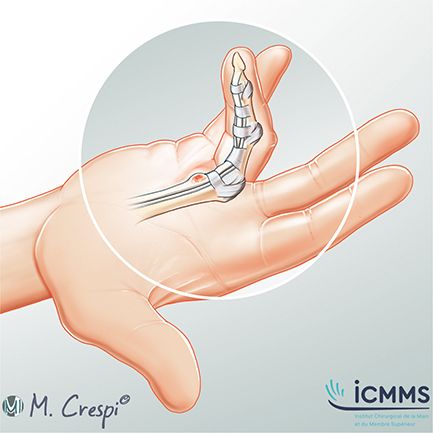
What is trigger finger?
The flexor tendons glide inside a sheath held in place by fibrous rings, the pulleys. When the tendon thickens or the first pulley (the A1 pulley, at the base of the finger) narrows, the tendon catches as it passes through. The thumb, ring finger and middle finger are the most often affected.
What are the symptoms?
- Pain at the base of the finger, in the palm
- A small tender lump under the skin
- Triggering: the finger locks and then suddenly releases
- Locking on waking in the morning, sometimes a finger stuck in a bent position that has to be straightened with the other hand
What are the treatments?
- Corticosteroid injection into the tendon sheath: this is often the first treatment and works in many cases
- Surgery: offered if the injection fails or symptoms recur, or straight away in some situations (locked finger, diabetes)
How is the operation performed?
The operation consists of opening the A1 pulley through a short incision in the palm. It takes a few minutes and is done as a day case.
It is particularly well suited to wide-awake local anaesthesia with no tourniquet (WALANT): being awake, you can bend your finger during the procedure, which allows immediate confirmation that the triggering has gone.
After the operation
- Finger movement from the day of the operation
- A simple dressing until the wound has healed, usually two weeks
- Gradual return to activities; no heavy gripping for 2 to 3 weeks
- Tenderness of the scar may last 2 to 3 months
Frequently asked questions
Is an injection always enough?
No. It is often effective, but symptoms can come back. Surgery is then offered.
Can several fingers be treated at the same time?
Yes, several fingers can be released during the same operation.
Can children get trigger finger?
Yes, mainly in the thumb (trigger thumb in children). Treatment is usually surgical from the outset.
Consultations in Lyon
Dr Maxime Cievet-Bonfils sees patients at:
- ICMMS – Centre Eiffel, 18-20 rue Tronchet, 69006 Lyon (3rd floor)
- Clinique de l'Infirmerie Protestante, 3 chemin du Penthod, 69300 Caluire-et-Cuire (Building D, 4th floor)
Secretary (direct line): +33 4 87 25 83 35 · Consultations in French or English.
This page provides general information. It does not replace a consultation: every situation is different.