Thumb sprain (skier's thumb)
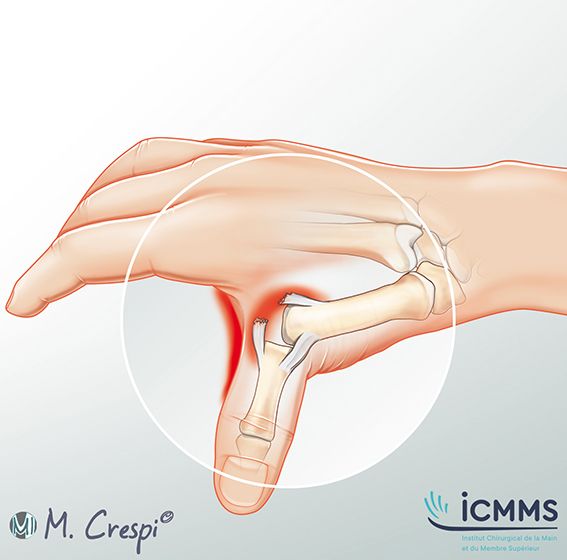
A thumb sprain, or "skier's thumb", is an injury to the ligament at the base of the thumb, on the index finger side (the ulnar collateral ligament of the metacarpophalangeal joint). It happens when the thumb is forced away from the hand, typically in a skiing fall with the pole in your hand, and makes pinching between thumb and index finger painful and unstable. A splint is enough for mild sprains; but surgery is needed when the ligament is ruptured and displaced (Stener lesion, or Stener effect), because it cannot heal in place.
What is a thumb sprain?
The metacarpophalangeal joint connects the first metacarpal to the first phalanx of the thumb. On its inner edge, on the index finger side, the ulnar collateral ligament stops the joint from opening when you pinch an object. When the thumb is suddenly forced away from the hand, this ligament can be stretched (mild sprain), completely torn (severe sprain), or pull off a small fragment of bone from the phalanx.
In some complete ruptures, the torn ligament flips over and becomes trapped above a fibrous sheet belonging to one of the thumb muscles (the adductor aponeurosis). This is the Stener lesion (Stener effect): the ligament can no longer reach the bone and does not heal on its own, however long the thumb is immobilised.
Skiing is the classic cause, but this sprain also happens in falls onto the hand, ball sports, combat sports or cycling.
What are the symptoms?
- Pain at the base of the thumb, on the index finger side
- Swelling and bruising around the joint
- Sometimes a small lump that can be felt, which may be the flipped-over ligament
- Painful, weak pinch between thumb and index finger: difficulty turning a key, opening a jar or holding a sheet of paper
- A feeling that the thumb "gives way" or opens abnormally when gripping
How is it diagnosed?
The surgeon gently tests the stability of the joint, comparing it with the other thumb. X-rays look for a bony avulsion (a fragment of bone pulled off) or an associated fracture. An ultrasound scan, performed by an experienced operator, shows the ligament, determines whether it is stretched or ruptured and looks for a Stener lesion.
Seek medical advice promptly after the injury, ideally within the first few days: a rupture recognised early is simpler to repair than long-standing instability. A hand emergency consultation is possible.
What are the non-surgical treatments?
When the ligament is only stretched, or ruptured but still in place under the aponeurosis, it can heal without an operation:
- A custom-made splint immobilising the metacarpophalangeal joint of the thumb, leaving the wrist and the tip of the thumb free, usually worn for 4 to 6 weeks
- Painkillers and ice in the first few days
- Rehabilitation after immobilisation to recover movement and pinch strength
A small undisplaced bony avulsion can also be treated with a splint.
When is surgery needed?
Surgery is needed in the following situations:
- a Stener lesion, which only surgery can correct
- a complete rupture with a clearly unstable joint
- a displaced bony avulsion or a large joint fragment
- chronic instability, painful or troublesome, after an old sprain that healed poorly
How is the operation performed?
Through an incision on the inner edge of the base of the thumb, the surgeon frees the ligament, puts it back in place and fixes it to the bone, most often with a small anchor (a mini-implant that acts as an attachment point). A displaced bone fragment is fixed with a pin (K-wire) or a small screw. In long-standing instability, when the ligament can no longer be repaired, reconstruction with a tendon graft or, if there is osteoarthritis, fusion of the joint (arthrodesis) may be discussed.
The operation is done as a day case, under regional anaesthesia of the arm.
After the operation
- The thumb is protected by a splint, usually for 4 to 6 weeks
- Rehabilitation starts immediately after the operation, protected by the splint, to recover movement and then pinch strength
- Return to sports that put the thumb at risk is gradual, often with protection
- A feeling of stiffness or thickening of the joint may persist for a few months
Possible complications (stiffness, irritation of a small sensory nerve branch, infection, residual instability) are explained to you at the consultation.
Frequently asked questions
Why is this injury called "skier's thumb"?
Because it very often happens in a skiing fall: the pole, held by its wrist strap, suddenly forces the thumb away from the rest of the hand.
What happens if a severe thumb sprain is not treated?
Lasting instability of the pinch between thumb and index finger, with pain, loss of strength and, in the long term, wear of the joint. Early diagnosis usually prevents these after-effects.
Can I ski with a thumb sprain?
It is better to stop and seek medical advice. Carrying on with an unstable thumb risks making the injury worse; after treatment, a protective splint makes returning easier.
Do I need an ultrasound scan?
It is very useful when a severe sprain is suspected, because it shows whether the ligament can heal in place or whether there is a Stener lesion that needs an operation.
Consultations in Lyon
Dr Maxime Cievet-Bonfils sees patients at:
- ICMMS – Centre Eiffel, 18-20 rue Tronchet, 69006 Lyon (3rd floor)
- Clinique de l'Infirmerie Protestante, 3 chemin du Penthod, 69300 Caluire-et-Cuire (Building D, 4th floor)
Secretary (direct line): +33 4 87 25 83 35 · Consultations in French or English.
This page provides general information. It does not replace a consultation: every situation is different.