Mucous cyst of the finger
A mucous cyst is a small lump filled with joint fluid, located on the back of the finger between the last joint and the nail. It is almost always linked to osteoarthritis of the last joint of the finger and can deform the nail. It is benign; when it is troublesome, a short operation under local anaesthesia removes the cyst and the bone spurs that feed it.
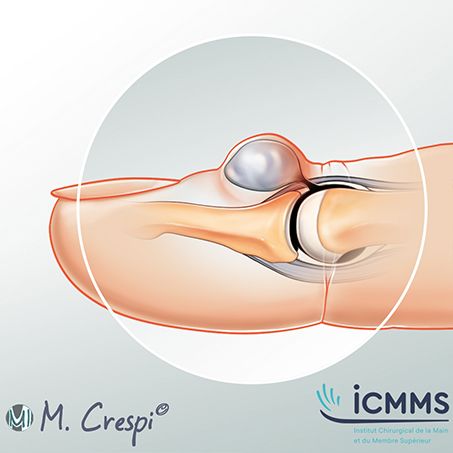
What is a mucous cyst?
The last joint of the finger, the distal interphalangeal joint, is surrounded by a capsule containing the joint fluid. When this joint wears (finger arthritis), bone spurs (osteophytes) form and the capsule weakens. Fluid then escapes and forms a pouch under the skin, connected to the joint by a small channel: this is the mucous cyst.
It most often appears after the age of 50, slightly more often in women. It is not a malignant tumour and it does not turn into one.
What are the symptoms?
- A small firm or soft lump a few millimetres across, on the back of the finger, often slightly to one side, between the last joint and the nail
- Thin, sometimes translucent skin over the cyst
- Nail deformity: a groove or lengthwise ridges, when the cyst presses on the area that produces the nail (the matrix)
- Pain when knocked, or joint pain linked to the osteoarthritis
- Leakage of a clear fluid as thick as jelly when the cyst bursts
A cyst that opens on its own or that you pierce yourself exposes the joint to infection. Do not pierce it with a needle at home. Seek medical advice promptly if the finger becomes red, warm and painful.
How is it diagnosed?
The appearance and location are usually enough for the diagnosis. An X-ray of the finger shows the osteoarthritis of the last joint and the osteophytes, which helps to plan the operation. An ultrasound scan is sometimes useful if it could be another kind of lump in the finger; an MRI is only exceptionally needed.
What are the non-surgical treatments?
- Monitoring: a cyst that causes no trouble does not need treatment. It may vary in size, or even disappear temporarily
- Aspiration of the cyst (draining it with a needle), possibly combined with a corticosteroid injection: it can bring relief, but the cyst often comes back because its cause, the osteoarthritis, remains
- A resting splint during a painful flare-up of the osteoarthritis
When is surgery needed?
Surgery is offered when the cyst:
- is painful, particularly when knocked
- deforms the nail or disturbs its growth
- repeatedly opens, with a risk of joint infection
- is a significant cosmetic concern for you
How is the operation performed?
The surgeon removes the cyst together with its stalk, that is, the part of the capsule through which it connects with the joint. The surgeon also removes the osteophytes on the back of the joint, which cause the fluid leak: this step is what limits the risk of recurrence. When the skin over the cyst is very thin, it is removed and the area is covered with a small flap of neighbouring skin.
The operation usually takes about twenty minutes and is done as a day case, under anaesthesia of the finger. You go home the same day.
After the operation
- A dressing protects the finger until the wound has healed, usually about two weeks
- A small splint holding the last joint straight is sometimes worn for a few days to a few weeks
- The nail deformity gradually improves as the nail grows back, which takes several months
- Some stiffness or mild swelling of the fingertip may persist for a while
Complications are rare: infection, stiffness of the last joint, recurrence of the cyst, persistent nail abnormality. They are explained to you at the consultation.
Frequently asked questions
Is a mucous cyst serious?
No, it is a benign lesion. It is a sign of osteoarthritis of the last joint of the finger and never develops into cancer.
Can I pierce the cyst myself?
No. The cyst connects with the joint: piercing it opens a way in for germs and can cause a serious joint infection.
Can the cyst come back after the operation?
It is possible but uncommon when the osteophytes have been removed. However, osteoarthritis elsewhere can cause a cyst to appear on another finger.
Will my nail return to normal?
In most cases the nail improves markedly once the pressure from the cyst is removed. You need to wait for the nail to grow back completely, which takes several months, to judge the result.
Consultations in Lyon
Dr Maxime Cievet-Bonfils sees patients at:
- ICMMS – Centre Eiffel, 18-20 rue Tronchet, 69006 Lyon (3rd floor)
- Clinique de l'Infirmerie Protestante, 3 chemin du Penthod, 69300 Caluire-et-Cuire (Building D, 4th floor)
Secretary (direct line): +33 4 87 25 83 35 · Consultations in French or English.
This page provides general information. It does not replace a consultation: every situation is different.