Finger arthritis
Finger arthritis (osteoarthritis) is wear of the cartilage in the small joints of the fingers, most often the middle joint of the finger (proximal interphalangeal joint) or the joint at the tip of the finger (distal interphalangeal joint). It causes pain, stiffness and deformities in the form of nodules. Treatment first relies on painkillers, splints and injections; if these fail, a replacement of the middle finger joint (prosthesis) or fusion of the joint (arthrodesis) may be offered.
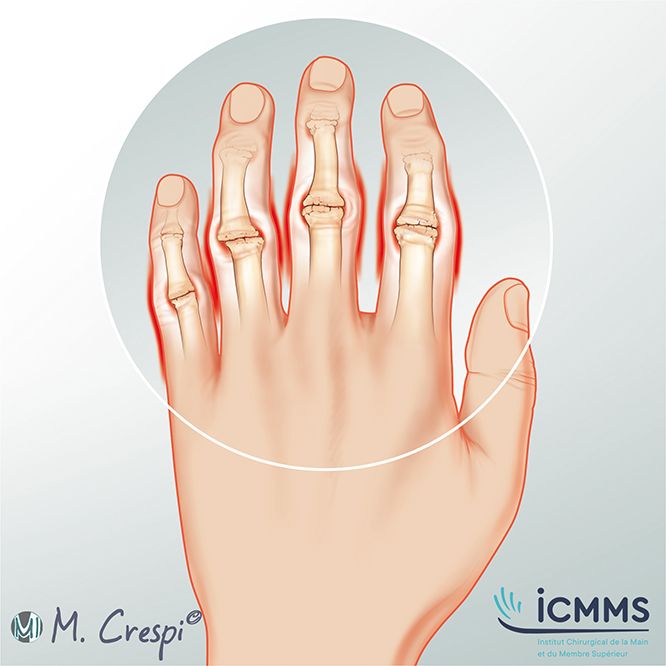
What is finger arthritis?
Each long finger has two joints between its phalanges (finger bones): the proximal interphalangeal joint (PIP), in the middle of the finger, and the distal interphalangeal joint (DIP), near the nail. The cartilage covering the ends of the bones allows them to glide without friction. When it wears away, the bone reacts by forming outgrowths (osteophytes) that deform the joint.
Finger arthritis is very common, particularly in women after the menopause, and has a strong hereditary component. An old finger injury (a fracture involving the joint, a severe sprain) can also lead to osteoarthritis limited to a single joint.
What are the symptoms?
- Joint pain during gripping or pinching, sometimes at rest during flare-ups
- Stiffness, especially in the morning or after a period of inactivity
- Swelling and warmth of the joint during inflammatory flare-ups
- Bony nodules: Bouchard's nodes in the middle of the finger, Heberden's nodes at the tip of the finger
- Gradual sideways deviation of the finger, loss of strength and difficulty with fine movements
- Sometimes a small cyst near the nail (mucous cyst), linked to osteoarthritis of the last joint
How is it diagnosed?
The clinical examination identifies the affected joints, their movement, their stability and their impact on how the hand works. X-rays of the hand and fingers confirm the wear (narrowing of the joint space, osteophytes) and show the degree of damage. A CT scan is sometimes requested before surgery. A blood test can be useful when the pattern suggests inflammatory arthritis.
What are the non-surgical treatments?
- Painkillers and anti-inflammatory medicines, particularly as a gel or a short course during flare-ups
- Resting splints, worn at night or during painful activities, to rest the joint
- Corticosteroid injection into the joint, useful during inflammatory flare-ups
- Rehabilitation: advice on protecting the joints, assistive devices, exercises to maintain movement
- Applying heat or cold, whichever gives relief
Osteoarthritis progresses in flare-ups: a joint that is very painful for a few months can then settle and become less troublesome, even though it remains deformed.
When is surgery needed?
Surgery is considered when pain, stiffness or deformity become disabling despite well-conducted medical treatment. The choice of technique depends on the joint, the finger concerned, the condition of the ligaments and tendons, and your needs (strength, precision, movement).
How is the operation performed?
There are two main options:
- Proximal interphalangeal joint replacement: the worn middle joint of the finger is replaced with an implant. The aim is to relieve pain while preserving useful movement. It is mainly offered for the middle, ring and little fingers, which need to bend for a full grip
- Arthrodesis (fusion): the joint is permanently fixed in a functional position, with pins (K-wires) or a screw. It relieves pain and gives a stable, strong finger, but with no movement at that level. It is the usual solution for the joint at the tip of the finger, and often for the index finger, which is heavily used in side pinch
Osteophytes, inflamed joint lining (synovium) or an associated cyst can be removed at the same time. The operation is done as a day case, under regional anaesthesia of the arm.
After the operation
- After a joint replacement, rehabilitation starts early, with a splint and hand therapy (physiotherapy) sessions for several weeks; it is essential to recover movement
- After an arthrodesis, the finger is protected until the bone has healed, usually 6 to 8 weeks
- Swelling of the finger may persist for several months
- Return to strenuous effort is gradual
Possible complications (stiffness, infection, wear or loosening of the prosthesis, failure of an arthrodesis to heal, complex regional pain syndrome) are explained to you at the consultation.
Frequently asked questions
Can finger arthritis be stopped from progressing?
No treatment regenerates cartilage. However, splints, adapting how you use your hands and treating flare-ups help limit pain and preserve function.
Does a finger joint replacement restore normal movement?
Its main aims are to relieve pain and preserve useful movement. The movement achieved depends largely on the stiffness before the operation and on rehabilitation.
Do all affected fingers need an operation?
No. Only joints that remain painful or very troublesome despite medical treatment are operated on, one at a time or with procedures grouped together depending on the case.
Do the nodules disappear after the operation?
The surgeon can remove the bony outgrowths from the joint operated on. Nodules on the other fingers, which are not operated on, remain.
Consultations in Lyon
Dr Maxime Cievet-Bonfils sees patients at:
- ICMMS – Centre Eiffel, 18-20 rue Tronchet, 69006 Lyon (3rd floor)
- Clinique de l'Infirmerie Protestante, 3 chemin du Penthod, 69300 Caluire-et-Cuire (Building D, 4th floor)
Secretary (direct line): +33 4 87 25 83 35 · Consultations in French or English.
This page provides general information. It does not replace a consultation: every situation is different.