Kienböck's disease
Kienböck's disease is osteonecrosis of the lunate, a small bone in the centre of the wrist, which gradually loses its blood supply, becomes fragile and then collapses. It mainly affects young adults and causes pain on the back of the wrist, swelling and stiffness. Treatment depends on the stage: immobilisation at the start, then surgery to offload the bone or restore its blood supply, or to relieve a wrist that is already worn.
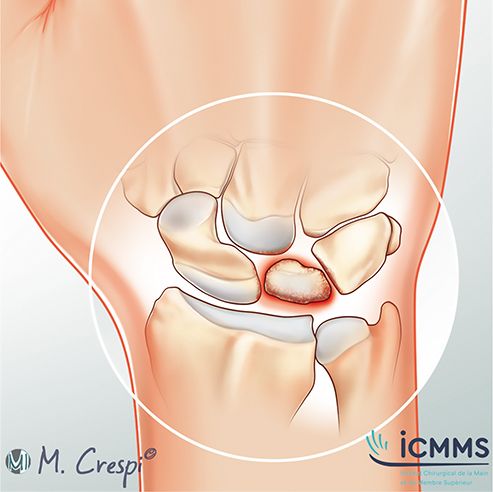
What is Kienböck's disease?
The lunate is one of the eight carpal bones. Located in the centre of the wrist, facing the radius, it receives a large part of the pressure transmitted from the hand. Its blood supply is sometimes fragile.
In Kienböck's disease, the bone loses part of its blood supply: this is osteonecrosis (death of bone due to a lack of blood supply). The lunate becomes denser, then breaks up and collapses. The neighbouring bones shift out of alignment and, eventually, wrist arthritis can develop.
The exact cause remains unknown. Several factors have been suggested: a particular pattern of blood supply to the lunate, repeated minor injuries, the shape of the bone, or a radius that is longer than the ulna (negative ulnar variance), which increases the pressure on the lunate. The disease progresses slowly, in several stages, over months or years.
What are the symptoms?
- Pain on the back of the wrist, in the centre, sometimes starting suddenly as if after a sprain
- Swelling on the back of the wrist
- Gradual stiffness, especially when bending the wrist back
- Loss of grip strength
- In advanced stages, cracking and arthritic pain
How is it diagnosed?
- X-rays: they may be normal at the very beginning, then show a lunate that is whiter (denser), broken up or collapsed. They also measure the relative length of the radius and the ulna.
- MRI scan: this is the key test at the early stage. It shows the damage to the bone before the X-ray becomes abnormal.
- CT scan or CT arthrogram: it shows the fragmentation of the lunate and the condition of the cartilage in detail, which helps to choose the treatment.
The stage of the disease, defined from these tests, guides the decision. A recent fracture of the lunate or another cause of pain in the centre of the wrist must be ruled out.
What are the non-surgical treatments?
In the early stages, particularly in teenagers and young adults:
- Immobilisation of the wrist with a splint or a plaster cast, sometimes for several months, to reduce the pressure on the lunate
- Painkillers and anti-inflammatory medication
- Adapting manual and sports activities
Regular imaging checks how the disease is progressing.
When is surgery needed?
Surgery is considered when the pain persists despite treatment, when the disease progresses or when the lunate has already collapsed. The procedure depends on the stage, the shape of the forearm bones, the condition of the cartilage and your age.
How is the operation performed?
The operations are done under regional anaesthesia (anaesthesia of the arm).
When the lunate is still intact, the aim is to protect it and allow its blood supply to return:
- Radial shortening osteotomy: when the radius is longer than the ulna, it is shortened by a few millimetres and fixed with a plate, which reduces the pressure on the lunate.
- Vascularised bone graft: a piece of bone taken together with the blood vessel that feeds it, usually from the nearby radius, is placed into the lunate to bring blood back to it. This procedure uses microsurgery.
When the lunate is broken up or the wrist is worn, the aim is to relieve pain while preserving as much movement as possible:
- Proximal row carpectomy: removal of the scaphoid, the lunate and the triquetrum
- Partial fusion (partial arthrodesis): fusing some of the carpal bones together to offload the lunate
- Wrist denervation, alone or combined with another procedure
- Total fusion (total arthrodesis) of the wrist, as a last resort
Wrist arthroscopy (keyhole surgery) is often useful to assess the cartilage precisely before choosing the procedure.
After the operation
- Immobilisation for several weeks is usual, until the bone or the graft has healed
- Rehabilitation is then prescribed to regain movement and strength
- Full recovery usually takes several months
- X-ray monitoring continues
Possible complications (stiffness, failure of bone healing, discomfort from the implants, complex regional pain syndrome) are explained to you at your consultation.
Frequently asked questions
Can Kienböck's disease be cured?
In the early stages, especially in young people, the lunate can regain its blood supply with suitable treatment. In advanced stages, treatment aims to relieve pain and preserve function.
Is it a hereditary or a general (whole-body) disease?
No. It affects a single bone, in a single wrist in the vast majority of cases, and is not linked to a general disease.
Is my manual work to blame?
Repeated minor injuries are a possible factor, but not the only cause. Possible recognition as an occupational disease is discussed on a case-by-case basis.
Do I need to stop sport?
Sports that put weight-bearing or impact strain on the wrist are usually suspended during treatment. Return is decided according to how the imaging and the pain evolve.
Consultations in Lyon
Dr Maxime Cievet-Bonfils sees patients at:
- ICMMS – Centre Eiffel, 18-20 rue Tronchet, 69006 Lyon (3rd floor)
- Clinique de l'Infirmerie Protestante, 3 chemin du Penthod, 69300 Caluire-et-Cuire (Building D, 4th floor)
Secretary (direct line): +33 4 87 25 83 35 · Consultations in French or English.
This page provides general information. It does not replace a consultation: every situation is different.