Wrist ganglion cyst
A wrist ganglion cyst is a small, harmless (benign) pouch filled with thick fluid, connected to a joint of the wrist. It forms a lump, most often on the back of the wrist, sometimes on the palm side, which may be painless or may get in the way of movement. A cyst that causes no trouble can simply be monitored; if it is painful or bothersome, it can be removed through a short incision or by arthroscopy (keyhole surgery).
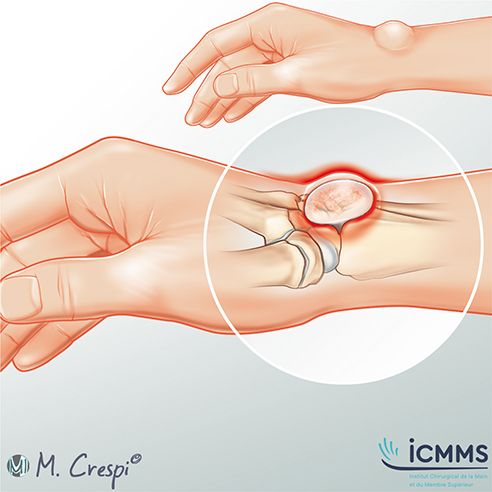
What is a ganglion cyst?
A ganglion cyst (also called a "synovial cyst" or "ganglion") arises from the capsule of a wrist joint. A small stalk links the pouch to the joint: the thicker joint fluid passes through it and collects in the pouch. It is not a malignant tumour and it does not turn into one.
- The dorsal ganglion, the most common, most often arises over the scapholunate ligament, on the back of the wrist.
- The palmar (volar) ganglion is located on the front of the wrist, often against the radial artery, where you take your pulse.
It mainly affects young adults, but can appear at any age, including in children. The precise cause remains unknown; repeated strain or an injury to the wrist can bring it to light. The cyst that forms on the back of the finger near the nail is a different condition, the mucous cyst.
What are the symptoms?
- A round, well-defined lump, firm or tense (taut like a balloon), on the back or the front of the wrist
- Variable size: it often gets bigger after effort and smaller with rest
- Pain or discomfort in extreme positions, for example when putting weight on the hand with the wrist bent back (press-ups, yoga)
- Sometimes no visible lump: a small "occult" (hidden) cyst can be painful without being seen
- More rarely, tingling if the cyst presses on a nerve
How is it diagnosed?
A clinical examination is often enough. An ultrasound scan confirms the fluid content, shows where the cyst starts and, for a palmar cyst, its relationship with the radial artery. X-rays of the wrist check that there is no associated bone abnormality or arthritis. An MRI scan is reserved for uncertain cases or occult cysts.
What are the non-surgical treatments?
- Monitoring: a painless cyst can be left alone. Some shrink or disappear on their own.
- Aspiration with a needle, always guided by ultrasound, sometimes followed by an injection: it empties the cyst and relieves symptoms, but there is a 50% risk of recurrence, because the stalk remains in place.
- Simple measures: temporarily limiting painful weight-bearing, a resting splint during flare-ups.
Crushing the cyst with a blow, an old practice, is not recommended.
When is surgery needed?
Removal is offered when the cyst is painful, interferes with your activities, comes back after aspiration or is a cause of worry. There is no urgency: it is a choice you make once you have been informed.
How is the operation performed?
The principle is to remove the cyst with its stalk and the area of joint capsule from which it arises, to limit recurrence. The operation is done as a day case. Two techniques are possible:
- Open surgery: through a short incision over the cyst. It is done under regional anaesthesia of the arm.
- Arthroscopic surgery: through two or three incisions of a few millimetres, the cyst is treated from inside the joint. This technique, suited mainly to dorsal cysts, leaves more discreet scars and makes it possible to check the condition of the wrist ligaments. It is done under regional anaesthesia.
The choice is discussed at your consultation, depending on the location of the cyst and your expectations.
After the operation
- A dressing is kept on for about two weeks; a splint is usually worn for 15 days
- The fingers are moved immediately for light tasks
- Temporary stiffness of the wrist is common and recovers with suitable rehabilitation
- Return to weight-bearing on the hand and to effort is gradual over a few weeks
Complications are rare: infection, haematoma, tender scar, irritation of a sensory nerve branch, complex regional pain syndrome. Recurrence remains possible, estimated at about 10% after arthroscopy.
Frequently asked questions
Is a wrist ganglion dangerous?
No. It is a benign lesion that does not turn into cancer. If there is any doubt about the nature of a lump, an ultrasound scan can confirm the diagnosis.
Does a wrist ganglion have to be removed?
No. A painless cyst can be monitored. Surgery is reserved for cysts that are painful, bothersome or keep coming back.
Can the cyst come back after the operation?
Yes, it is possible (about 10% after arthroscopy), but much less often than after a simple aspiration (about 50%), because the stalk is removed together with the cyst.
Arthroscopy or a conventional incision: which should I choose?
Both techniques aim for the same result. Arthroscopy leaves smaller scars; the conventional incision can sometimes be done under local anaesthesia, on a case-by-case basis. The choice depends on the location of the cyst and is discussed at your consultation.
Consultations in Lyon
Dr Maxime Cievet-Bonfils sees patients at:
- ICMMS – Centre Eiffel, 18-20 rue Tronchet, 69006 Lyon (3rd floor)
- Clinique de l'Infirmerie Protestante, 3 chemin du Penthod, 69300 Caluire-et-Cuire (Building D, 4th floor)
Secretary (direct line): +33 4 87 25 83 35 · Consultations in French or English.
This page provides general information. It does not replace a consultation: every situation is different.