Scaphoid nonunion
Scaphoid nonunion is the failure of a fracture of this small wrist bone to heal. It often follows a fracture that went unnoticed, mistaken for a sprain, and shows up as pain on the thumb side of the wrist. Without treatment, it progresses to arthritis: it is usually treated with a bone graft combined with a screw, through an open incision or by arthroscopy (keyhole surgery). Stopping smoking completely is essential.
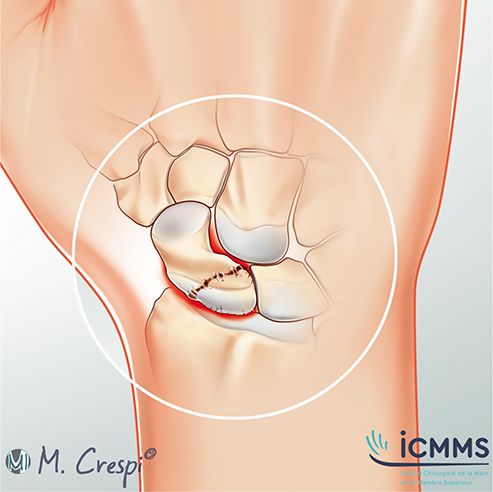
What is the scaphoid?
The scaphoid is one of the eight carpal bones (the small bones of the wrist). Located at the base of the thumb, it links the two rows of wrist bones and plays a key role in the wrist's stability. Its blood supply is fragile: blood enters mainly through its end nearest the thumb, so a fracture can deprive the opposite fragment (the proximal pole) of its blood supply and hinder healing.
A recent scaphoid fracture: an injury that is easy to miss
Scaphoid fracture most often occurs in young adults, after a fall on the hand with the wrist bent back or a sports impact. It is often not very dramatic: little swelling, no deformity, moderate pain that suggests a "sprained wrist".
- The pain is at the base of the thumb, in the hollow on the back of the wrist (the anatomical snuffbox)
- The fracture line is often invisible on the first X-rays
- A CT scan of the wrist is the most useful test to confirm or rule out the fracture and to measure its displacement; an MRI scan is an alternative
A recent non-displaced fracture most often heals with 3 months of immobilisation. A displaced fracture, or a fracture in a patient who wishes to limit immobilisation, can be fixed with a screw inserted through the skin. Any "sprained wrist" that remains painful after a fall therefore deserves a medical opinion and, if needed, a CT scan.
What are the symptoms of nonunion?
- Pain on the thumb side of the wrist when putting weight on the hand (press-ups, getting up from a chair) or during effort
- Loss of strength and movement, especially when bending the wrist back
- Moderate swelling
- Sometimes very few symptoms for years, the nonunion being discovered on an X-ray taken after a new injury
How is it diagnosed?
X-rays often show the unhealed fracture line. A CT scan shows the appearance of the fragments in detail, as well as any bone loss, tilting of the scaphoid and possible arthritis. An MRI scan is sometimes requested to assess whether the proximal pole is still alive (its vitality), which guides the choice of technique.
Without treatment, nonunion changes the way the wrist works and gradually leads to wrist arthritis (known as SNAC: *scaphoid nonunion advanced collapse*).
What are the non-surgical treatments?
An established nonunion does not heal with immobilisation alone. Painkillers and a splint can give temporary relief, but do not stop the progression to arthritis. Non-surgical treatment is mainly considered for patients who are only mildly bothered, or when the arthritis is already very advanced.
When is surgery needed?
Surgery is offered as soon as the nonunion is diagnosed, before arthritis develops, to obtain healing and preserve the wrist. The earlier it is treated, the simpler the repair.
Why do you need to stop smoking completely?
Smoking prevents the scaphoid from healing: it promotes nonunion after a fracture, and it prevents the bone graft from healing after the operation. No smoking at all is acceptable during the treatment of a scaphoid fracture or nonunion.
How is the operation performed?
The principle is to remove the fibrous tissue between the fragments, fill the gap with a bone graft and fix the scaphoid, most often with a screw, or sometimes with pins (K-wires).
- Open surgery: the graft bone is taken from the radius, at the wrist, or from the crest of the hip bone depending on the amount needed; a vascularised graft (with its own blood vessel) may be offered when the proximal pole has a poor blood supply
- Arthroscopic surgery: for some nonunions, the bone graft and the screw are placed through small incisions, using a camera inserted into the wrist; this technique preserves the ligaments and the blood supply of the scaphoid
The choice depends on the location of the fracture line, the bone loss, the vitality of the fragments and the condition of the cartilage. The operation is done under regional anaesthesia of the arm, most often as a day case. When arthritis is present, other procedures (partial fusion of the wrist, or partial wrist arthrodesis) are discussed.
After the operation
- Immobilisation in a splint or a wrist cast is worn for several weeks
- Healing is checked with a CT scan, because X-rays alone are not reliable for confirming it
- Rehabilitation starts after healing to regain movement and strength
- Return to weight-bearing sports and heavy manual work usually takes several months
Frequently asked questions
I had a "sprained wrist" years ago and now it hurts: is that possible?
Yes. A scaphoid nonunion can remain silent for a long time and then become painful; an X-ray and a CT scan make it possible to assess the situation.
Is arthroscopic grafting possible for everyone?
No. It is suitable for some nonunions, depending on the bone loss, the tilting of the scaphoid and the condition of the cartilage; the CT scan helps to choose the most suitable technique.
Why does the scaphoid heal poorly?
Because its blood supply is fragile and it is subjected to considerable stress with every movement of the wrist; late diagnosis, insufficient immobilisation and smoking all promote nonunion.
What happens if I do not have surgery?
The risk is gradual progression to wrist arthritis, with pain, stiffness and loss of strength, which then limits the repair options.
Consultations in Lyon
Dr Maxime Cievet-Bonfils sees patients at:
- ICMMS – Centre Eiffel, 18-20 rue Tronchet, 69006 Lyon (3rd floor)
- Clinique de l'Infirmerie Protestante, 3 chemin du Penthod, 69300 Caluire-et-Cuire (Building D, 4th floor)
Secretary (direct line): +33 4 87 25 83 35 · Consultations in French or English.
This page provides general information. It does not replace a consultation: every situation is different.