Synovial chondromatosis and loose bodies of the elbow
Synovial chondromatosis of the elbow (also called synovial osteochondromatosis) is a rare disease of the membrane lining the inside of the joint: it produces small nodules of cartilage that break off and become loose bodies inside the elbow. They cause pain, swelling and locking. Treatment consists of removing them arthroscopically, together with the diseased lining.
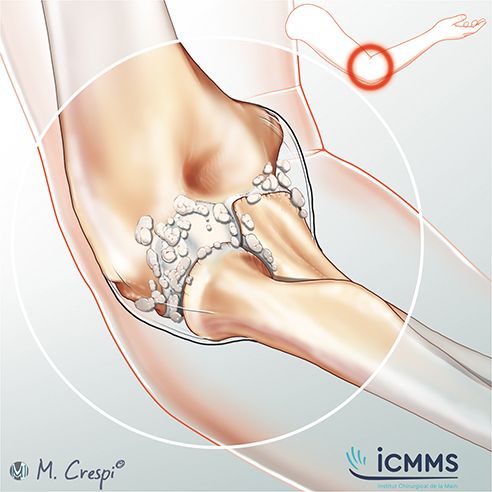
What is synovial chondromatosis of the elbow?
The inside of the elbow is lined by the synovial membrane, which produces joint fluid. In synovial chondromatosis, this membrane forms nodules of cartilage (chondromas), which can grow, calcify and then break off. They are then called loose bodies, and there are sometimes a great many of them.
The disease is benign. It most often affects young or middle-aged adults, in one elbow only. Left untreated, these fragments can wear the cartilage and lead to arthritis.
Other causes can create loose bodies in the elbow:
- Osteochondritis dissecans: in sporty teenagers (gymnastics, throwing sports), a fragment of bone and cartilage from the humeral condyle (the outer part of the lower end of the humerus) becomes weakened and can break off.
- Elbow arthritis and the after-effects of fractures, which produce fragments of bone and cartilage.
What are the symptoms?
- Elbow pain, often gradual
- Locking: the elbow suddenly gets stuck in one position, then releases
- Swelling of the joint
- Cracking or snapping during movement
- Loss of movement, especially of full straightening and bending
How is it diagnosed?
An X-ray shows the fragments when they are calcified. A CT arthrogram (CT scan after injection of contrast dye into the joint) or an MRI can detect nodules that are not yet calcified or are still attached to the lining, and assess their number and the condition of the cartilage. These scans also distinguish synovial chondromatosis from osteochondritis or arthritis.
What are the non-surgical treatments?
When the fragments cause no symptoms, simple monitoring is possible. Painkillers or anti-inflammatories can relieve a painful flare-up. However, no medication makes the fragments disappear or stops new nodules from forming.
When is surgery needed?
The operation is offered when pain, locking or loss of movement become troublesome, or when the fragments threaten the cartilage. Repeated locking is a good reason not to wait too long.
How is the operation performed?
The operation is most often done arthroscopically: a small camera and instruments are inserted into the elbow through several incisions a few millimetres long. The surgeon removes all visible loose bodies and, in synovial chondromatosis, removes all or part of the diseased synovial membrane (synovectomy) to limit the formation of new nodules. Areas of contracture or bony blocks can be treated at the same time. If the fragments are very numerous or large, a short additional incision is sometimes needed.
The operation is done as a day case, under regional anaesthesia of the arm.
After the operation
- The elbow is moved early, with no prolonged immobilisation
- Rehabilitation helps recover full movement
- Return to activities is gradual over a few weeks; return to sport and heavy work comes later
- X-ray monitoring is offered, because synovial chondromatosis can recur
Complications are rare (infection, stiffness, nerve injury) and are explained to you in consultation.
Frequently asked questions
Is synovial chondromatosis a serious tumour?
No. It is a benign disease of the joint lining. Malignant change is exceptional.
Why does my elbow lock?
A loose fragment gets caught between the joint surfaces and blocks movement. It then moves away, and the elbow releases.
Can the disease come back after the operation?
Recurrence is possible, especially if the diseased lining could not be removed entirely. This is why follow-up is arranged.
What is the difference with osteochondritis of the elbow?
Osteochondritis mainly affects sporty teenagers and is due to damage to a specific area of bone and cartilage, which can break off. Its treatment depends on the stability of the fragment and on age.
Consultations in Lyon
Dr Maxime Cievet-Bonfils sees patients at:
- ICMMS – Centre Eiffel, 18-20 rue Tronchet, 69006 Lyon (3rd floor)
- Clinique de l'Infirmerie Protestante, 3 chemin du Penthod, 69300 Caluire-et-Cuire (Building D, 4th floor)
Secretary (direct line): +33 4 87 25 83 35 · Consultations in French or English.
This page provides general information. It does not replace a consultation: every situation is different.