Olecranon bursitis (elbow bursitis)
Olecranon bursitis is a pocket of fluid that forms at the tip of the elbow, in a small gliding sac (bursa) just under the skin. It shows as a swelling that is often not very painful. Most non-infected bursitis settles with simple treatment; infected bursitis (red, hot, painful) needs prompt treatment, sometimes surgical.
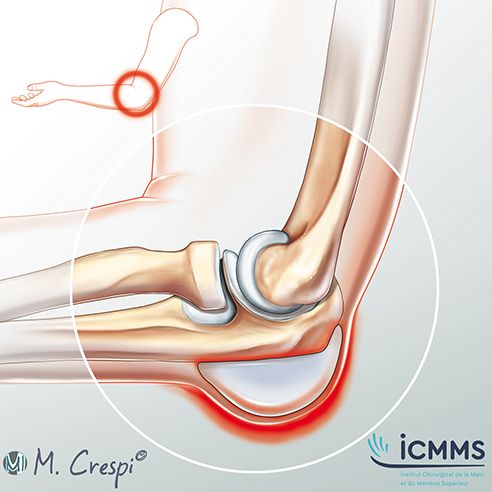
What is olecranon bursitis?
Between the skin and the bony tip of the elbow (the olecranon) lies a bursa, a small flattened sac that helps the skin glide. When it is irritated, it fills with fluid and swells: this is bursitis.
There are two very different situations:
- Non-infected (aseptic) bursitis: it is caused by repeated leaning on the elbow (desk work, jobs at floor level, sports), by a knock, or more rarely by an inflammatory disease such as gout or rheumatoid arthritis.
- Infected (septic) bursitis: germs enter the bursa, often through a small wound or graze in the skin of the elbow. This is an emergency.
What are the symptoms?
Non-infected bursitis:
- A rounded, soft swelling at the tip of the elbow, sometimes large
- Little or no pain; discomfort when leaning on it
- Elbow movement preserved
Infected bursitis:
- Redness, warmth and significant pain
- Tight skin, sometimes a wound or discharge
- Sometimes fever or a red streak running up the arm
How is it diagnosed?
Clinical examination is usually enough. If infection is suspected, aspirating the pocket allows the fluid to be analysed (looking for germs and gout crystals) and a blood test looks for signs of infection. An ultrasound scan can show the size of the pocket and an X-ray can look for a bone spur or a foreign body.
What are the non-surgical treatments?
Non-infected bursitis:
- Avoid leaning on the elbow, protect the area (elbow pad)
- Ice and anti-inflammatories for short periods
- Compression sleeve
- Aspiration of the fluid if the pocket is large or troublesome, bearing in mind that recurrence is common
Infected bursitis treated early:
- Antibiotics, sometimes combined with aspiration and immobilisation of the elbow for a few days, with close monitoring
When is surgery needed?
Surgery is indicated:
- for infected bursitis that does not improve quickly with antibiotics, or that presents from the start with an abscess, a wound or threatened skin
- for non-infected bursitis that keeps coming back despite treatment and remains troublesome
How is the operation performed?
The operation consists of removing the diseased bursa (bursectomy) through an incision at the back of the elbow. In the case of infection, it also includes careful cleaning and samples to identify the germ; antibiotics are continued afterwards. The operation is done as a day case, under regional anaesthesia of the arm or under local anaesthesia depending on the case.
After the operation
- A compression dressing is applied, sometimes with a splint for a few days to limit friction
- Leaning on the elbow is avoided for several weeks
- Healing of this area, which moves and takes pressure, needs monitoring
- In the case of infection, antibiotics are continued according to the sample results
Possible complications are mainly delayed wound healing, recurrence of the fluid or a scar that is tender when leaning on it. They are explained to you in consultation.
Frequently asked questions
How can I tell whether my bursitis is infected?
Redness, warmth, significant pain, a wound or fever should raise suspicion of infection. In that case, seek urgent medical advice.
Does bursitis need to be aspirated?
Not always. Aspiration relieves a large bursitis and allows the fluid to be analysed, but the pocket often fills up again if the leaning continues.
Can bursitis go away on its own?
Yes, non-infected bursitis often shrinks within a few weeks if you stop leaning on the elbow.
Can it come back after the operation?
It is possible but uncommon. Avoiding prolonged leaning on the elbow and wearing protection reduce this risk.
Consultations in Lyon
Dr Maxime Cievet-Bonfils sees patients at:
- ICMMS – Centre Eiffel, 18-20 rue Tronchet, 69006 Lyon (3rd floor)
- Clinique de l'Infirmerie Protestante, 3 chemin du Penthod, 69300 Caluire-et-Cuire (Building D, 4th floor)
Secretary (direct line): +33 4 87 25 83 35 · Consultations in French or English.
This page provides general information. It does not replace a consultation: every situation is different.