Elbow stiffness
Elbow stiffness is a loss of movement that prevents the arm from bending or straightening fully. It most often occurs after a fracture or a sprain of the elbow, because of scarring around the joint, excess bone or healing in a poor position. Rehabilitation is the first treatment; if the stiffness persists and is troublesome, an arthrolysis (surgical release of the joint), often performed arthroscopically, can restore movement.
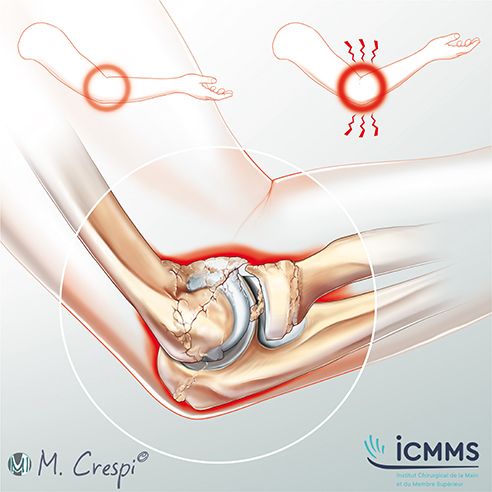
What is elbow stiffness?
The elbow is a joint that tends to stiffen easily after an injury. Several mechanisms, often combined, can be responsible:
- Contracture of the capsule (the fibrous envelope of the joint), which thickens and loses its elasticity
- Adhesions and scar tissue inside or around the joint
- Bony blocks: excess bone (osteophytes) or abnormal bone formation within the muscles (heterotopic ossification)
- Malunion: a fracture that has healed in a poor position
- Cartilage damage after a fracture involving the joint
Elbow fractures (radial head, olecranon, lower end of the humerus) and dislocations are the most common causes. Their initial treatment aims precisely to allow early movement, because prolonged immobilisation promotes stiffness. Stiffness can also be caused by arthritis or by loose bodies in the joint (synovial chondromatosis).
What are the symptoms?
- Inability to straighten the arm fully or to bend it all the way
- Difficulty bringing the hand to the mouth, face or back of the neck
- Sometimes difficulty turning the forearm (palm up or palm down)
- Pain at the end of the movement, a feeling of a block or of locking
- Sometimes tingling in the ring and little fingers, from irritation of the ulnar nerve
A slight loss of straightening is often well tolerated; a loss of bending is generally more troublesome in everyday life.
How is it diagnosed?
The examination precisely measures the range of bending, straightening and rotation, and looks for involvement of the ulnar nerve. X-rays check that the fracture has healed and look for bony blocks. A CT arthrogram shows the bony obstacles and the condition of the cartilage, which helps to plan any operation. An electromyogram (EMG, nerve conduction study) is requested if there are signs of nerve involvement.
What are the non-surgical treatments?
In the first months, stiffness can still improve with rehabilitation:
- Regular physiotherapy and exercises at home, without forcing through pain
- Dynamic or static progressive splints, which gradually put the joint under tension (bending or straightening)
- Painkillers and anti-inflammatories to make rehabilitation possible
- Botulinum toxin (Botox) injections into the biceps muscle: they relax the muscle, which stays contracted to protect the painful elbow, and help recover straightening during rehabilitation
When is surgery needed?
An arthrolysis is discussed when stiffness genuinely interferes with daily or working life and no longer improves despite well-conducted rehabilitation, usually several months after the injury, once the fracture has healed. The decision depends on how troublesome it is more than on the number of degrees lost.
How is the operation performed?
Arthrolysis consists of releasing the joint: cutting or removing the contracted capsule, and removing adhesions, bony blocks and any loose bodies. Depending on the cause, it is done:
- arthroscopically, through small incisions using a camera, when the lesions allow it
- as open surgery, through a larger incision, in the case of extensive ossification, malunion or hardware to be removed
The ulnar nerve is often released at the same time, especially if a large gain in bending is expected. The operation is done under regional anaesthesia of the arm, sometimes with a short hospital stay. In rare cases where the joint is badly damaged, an elbow replacement may be discussed.
After the operation
- Movement starts very early, often from the next day, to keep the gain obtained in the operating theatre
- Intensive rehabilitation and splints are continued for several weeks to several months
- Your active involvement is decisive for the result
It is common not to keep all the movement obtained during the operation. Possible complications (recurrence of stiffness, nerve injury, infection, complex regional pain syndrome) are explained to you in consultation.
Frequently asked questions
Can movement still be recovered several months after a fracture?
Yes. Rehabilitation can still bring progress for several months, and an arthrolysis can bring a gain even long after the injury.
Why does the elbow stiffen so easily?
Its capsule reacts strongly to injury and the three joints that make it up fit very closely together. This is why the aim is to move the elbow as early as possible after an injury.
Is arthrolysis painful?
The first few days can be uncomfortable, especially during rehabilitation. Pain is managed with anaesthesia of the arm, then with appropriate painkillers.
Will my elbow be normal again?
The aim is to recover useful movement for everyday life. The result depends on the cause of the stiffness and on the condition of the cartilage; it is explained to you in detail in consultation.
Consultations in Lyon
Dr Maxime Cievet-Bonfils sees patients at:
- ICMMS – Centre Eiffel, 18-20 rue Tronchet, 69006 Lyon (3rd floor)
- Clinique de l'Infirmerie Protestante, 3 chemin du Penthod, 69300 Caluire-et-Cuire (Building D, 4th floor)
Secretary (direct line): +33 4 87 25 83 35 · Consultations in French or English.
This page provides general information. It does not replace a consultation: every situation is different.