Lateral epicondylitis (tennis elbow)
Lateral epicondylitis, or "tennis elbow", is a disorder of the tendons attached to the outer side of the elbow. It causes pain on the outside of the elbow when gripping objects and when rotating the forearm. Treatment is first non-surgical and often long; surgery is only considered after prolonged failure of well-conducted treatment.
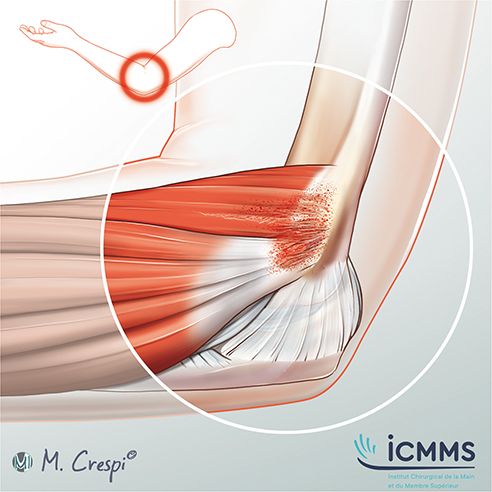
What is tennis elbow?
The muscles that straighten the wrist and fingers attach by a common tendon to a bony bump on the outer side of the elbow, the lateral epicondyle. Repeated strain or unusual effort causes small tears in this tendon, which heals poorly: today it is described as a tendinopathy (wear of the tendon) rather than pure inflammation.
Despite its name, tennis elbow rarely affects tennis players. It mainly affects adults aged 35 to 55 who perform repetitive movements: computer work, DIY, manual jobs, carrying loads. In some cases, it is associated with a slight instability of the elbow caused by slack outer ligaments (radial head micro-instability) or with compression of the posterior interosseous nerve under the arcade of Frohse.
What are the symptoms?
- Pain on the outer side of the elbow, which may spread down the forearm
- Pain when gripping objects, even light ones (cup, bottle, bag)
- Pain with twisting movements: turning a key, using a screwdriver, shaking hands
- A feeling of weakness in the hand
- Sometimes morning stiffness; in established cases, pain at rest
How is it diagnosed?
Diagnosis is mainly clinical: pressing on the epicondyle is painful, as is straightening the wrist or the middle finger against resistance. An X-ray rules out another cause (arthritis, after-effects of a fracture). If the pain persists, an ultrasound scan or an MRI shows the condition of the tendon (tear, detachment) and looks for an associated problem: compression of a forearm nerve (the posterior interosseous nerve), a fold of the joint lining (plica) or ligament instability.
What are the non-surgical treatments?
Non-surgical treatment is the rule as a first step. Tennis elbow usually heals without surgery, but healing takes time: several months, sometimes more than a year. Patience is part of the treatment.
- Reducing painful movements without fully immobilising the arm
- Adapting your workstation: vertical mouse, adapted keyboard, tools with thicker handles
- Rehabilitation: stretching and gradual strengthening of the forearm muscles, in particular with eccentric exercises (the muscle works while lengthening)
- Splint: a forearm strap worn during activities, a wrist splint at night
- Painkillers or anti-inflammatories for short periods
- Shockwave therapy or PRP injection (platelet-rich plasma, prepared from your own blood) in some resistant cases, particularly when the tendon is torn
Repeated corticosteroid injections are now avoided: they bring short-term relief but can weaken the tendon and lead to ligament degeneration.
When is surgery needed?
Surgery is only offered for persistent, disabling pain after well-followed non-surgical treatment over several months, usually at least six months to a year. It can also be discussed when imaging shows an associated problem that keeps the pain going (ligament instability, plica).
How is the operation performed?
The operation consists of removing the damaged part of the tendon to promote better-quality healing. It can be done arthroscopically: a camera and fine instruments are inserted into the elbow through small incisions, which also makes it possible to examine the joint and treat a plica. When instability is involved, the outer ligaments can be tightened at the same time.
The operation is done as a day case, most often under regional anaesthesia of the arm.
After the operation
- The elbow can be moved early for gentle movements, unless a ligament repair requires temporary protection
- Rehabilitation gradually resumes stretching, then strengthening
- Return to strenuous effort and sport is gradual, over several months
- The length of time off work depends on your job and on the procedure performed
Full recovery often takes several months. Complications are rare (infection, stiffness, nerve injury, complex regional pain syndrome) and are explained to you in consultation.
Frequently asked questions
Does tennis elbow heal on its own?
In the vast majority of cases, yes, but slowly: it often takes several months. Adapting your movements and following rehabilitation speeds up healing.
Do I have to stop sport or work completely?
Not necessarily. The aim is to reduce the movements that trigger the pain, not to immobilise the arm. Time off or temporary adjustments can be useful in manual jobs.
Do cortisone injections work?
They sometimes give quick relief, but their effect is often temporary and they do not change the long-term course. They risk weakening the tendon and leading to ligament degeneration: it is better not to use them any more.
What is the difference with a nerve compression?
Compression of the posterior interosseous nerve, in the forearm, can cause pain similar to tennis elbow, but located a little lower down. Clinical examination, and sometimes imaging, make it possible to tell them apart.
Consultations in Lyon
Dr Maxime Cievet-Bonfils sees patients at:
- ICMMS – Centre Eiffel, 18-20 rue Tronchet, 69006 Lyon (3rd floor)
- Clinique de l'Infirmerie Protestante, 3 chemin du Penthod, 69300 Caluire-et-Cuire (Building D, 4th floor)
Secretary (direct line): +33 4 87 25 83 35 · Consultations in French or English.
This page provides general information. It does not replace a consultation: every situation is different.