De Quervain's tenosynovitis
De Quervain's tenosynovitis is an inflammation of two thumb tendons where they glide through a narrow tunnel, on the thumb side of the wrist. It causes sharp pain when you move your thumb or pinch. Treatment first relies on rest, a splint and an injection; if the pain persists, a short operation under local anaesthesia opens this tunnel.
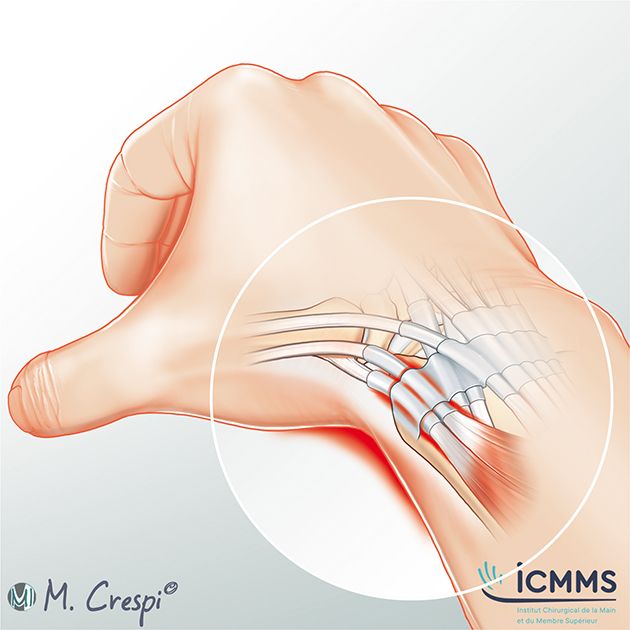
What is De Quervain's tenosynovitis?
Two tendons move the thumb outwards: the abductor pollicis longus and the extensor pollicis brevis. At the wrist, they run together through a fibrous channel, the first extensor compartment, which lies against a bony prominence of the radius (the radial styloid). When the sheath surrounding these tendons thickens and becomes inflamed (tenosynovitis), the tendons rub against the walls of the channel and pain appears.
This condition mainly affects women, often around the age of fifty, but also young mothers who carry their baby, during pregnancy or breastfeeding. Repetitive thumb and wrist movements (sewing, typing, gardening, carrying loads, using a smartphone) encourage or maintain the inflammation.
What are the symptoms?
- Pain on the thumb side of the wrist, sometimes spreading towards the thumb or the forearm
- Pain triggered by pinching between thumb and index finger, opening a jar, wringing out a cloth or lifting a saucepan
- Localised swelling, tender to pressure, over the radial styloid
- A feeling of stiffness, rubbing or crackling (crepitus) when moving the thumb
- Loss of grip strength, for fear of the pain
How is it diagnosed?
The diagnosis is above all clinical. The surgeon feels the painful area and performs Finkelstein's test: the thumb is folded into the palm with the fingers closed over it, then the wrist is tilted towards the little finger. Sharp pain on the side of the wrist strongly suggests De Quervain's tenosynovitis.
An ultrasound scan can confirm the thickening of the sheath and look for a septum dividing the two tendons into two tunnels, a common anatomical variant that can explain resistance to treatment. An X-ray rules out osteoarthritis of the base of the thumb (thumb base arthritis), which causes similar pain and can coexist.
What are the non-surgical treatments?
Medical treatment works in a large proportion of cases, especially when symptoms are recent:
- Resting the thumb and limiting repetitive pinching movements
- A splint immobilising the thumb and wrist, worn at night and during activities that trigger the pain
- A short course of anti-inflammatory medicines and applying cold
- Corticosteroid injection into the tendon sheath, often guided by ultrasound; it brings quick relief, but its effect may be temporary
- Rehabilitation with a hand therapist (physiotherapist) once the pain has settled, to adapt everyday movements
When is surgery needed?
Surgery is offered when the pain persists or recurs despite well-conducted medical treatment, usually after one or two injections, and when it interferes with work, sleep or everyday activities.
How is the operation performed?
Through a small incision on the side of the wrist, the surgeon opens the roof of the first compartment to give the tendons more room. The diseased sheath is removed if necessary, and any septum separating the two tendons is opened. The fine branches of the sensory nerve that run just under the skin at this point are identified and protected.
The operation takes about fifteen minutes and is done as a day case. It is performed under regional anaesthesia of the arm.
After the operation
- A dressing is left in place for a few days; the thumb can be used for light tasks
- Stitches are removed around day 12 to 15, depending on the technique used
- Return to strenuous effort is gradual over a few weeks; a few rehabilitation sessions can help
- The scar may remain tender for a few weeks
Complications are rare: irritation of the sensory branch of the radial nerve (tingling or a numb patch on the back of the thumb), a tender scar, infection, complex regional pain syndrome, or, exceptionally, the tendons snapping out of their tunnel. They are explained to you at the consultation.
Frequently asked questions
Does De Quervain's tenosynovitis get better on its own?
It can improve with rest, especially after a pregnancy or a period of overuse of the thumb. Once it has set in, a splint and an injection are usually needed to settle it.
Is the injection painful?
The injection is quick and done with a fine needle. Some pain may appear a day or two afterwards, then improvement usually follows within one to two weeks.
How long will I need off work after the operation?
It depends on your job: a few days for office work, several weeks for manual work that puts strain on the thumb and wrist.
Is it the same as wrist tendinitis?
It is a particular form of tendinitis, affecting a specific sheath on the thumb side of the wrist. Other causes of pain in this area, such as osteoarthritis of the base of the thumb, must be ruled out by the examination.
Consultations in Lyon
Dr Maxime Cievet-Bonfils sees patients at:
- ICMMS – Centre Eiffel, 18-20 rue Tronchet, 69006 Lyon (3rd floor)
- Clinique de l'Infirmerie Protestante, 3 chemin du Penthod, 69300 Caluire-et-Cuire (Building D, 4th floor)
Secretary (direct line): +33 4 87 25 83 35 · Consultations in French or English.
This page provides general information. It does not replace a consultation: every situation is different.