Flexor pulley injuries
A pulley injury is a tear of one of the fibrous rings that hold the flexor tendons against the finger bones. It mainly affects climbers and shows up as a pop, then pain at the base of the finger when gripping hard. Most isolated injuries heal with a protective ring and a gradual return to activity; ruptures of several pulleys with "bowstringing" require surgical reconstruction.
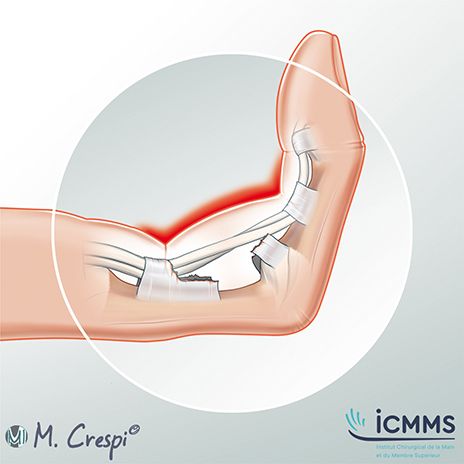
What is a pulley?
The flexor tendons, which bend the fingers, glide inside a sheath reinforced by fibrous rings called pulleys, numbered A1 to A5 from the base to the tip of the finger. They work like the guides on a fishing rod: they hold the tendon against the bone so that its pull is turned into effective bending. The A2 pulley (on the first phalanx) and the A4 pulley (on the second phalanx) are the most important.
In climbing, the "crimp" position (fingers hooked on a small edge, second phalanx bent at a sharp angle) puts very high loads on these pulleys. A foot slipping or a hold breaking is enough to rupture them. The middle and ring fingers are the most often affected.
What are the symptoms?
- A crack or "pop" felt, sometimes heard, at the moment of effort
- Pain on the palm side of the base of the finger, brought on by hard gripping
- Swelling and sometimes a haematoma (bruise)
- Loss of strength when squeezing or holding a hold
- If several pulleys are ruptured: the tendon moves away from the bone and sticks out when the finger is bent against resistance (bowstringing)
- Later on, difficulty fully straightening the finger
How is it diagnosed?
The clinical examination locates the pain and looks for bowstringing. Ultrasound is the key investigation: performed with the finger bending against resistance, it measures the distance between the tendon and the bone, which indicates how many pulleys are ruptured. An MRI is requested if there is doubt or to look for another injury (tendon, joint capsule, stress fracture in young climbers). These tests allow the injury to be classified: pulley strain, partial rupture, complete rupture of one pulley, or rupture of several pulleys.
What are the non-surgical treatments?
Injuries to a single pulley, even complete ones, are most often treated without an operation:
- rest from climbing and gripping efforts during the painful phase
- a protective ring (a thermoplastic ring or "H" taping) that holds the tendon against the bone while it heals
- gradual rehabilitation: movement, then strengthening, then a return to climbing starting on large holds
- protection with a ring or taping when returning to climbing, for several months
The total time before getting back to your previous level is counted in weeks for a strain and in months for a complete rupture.
When is surgery needed?
Surgery is offered:
- for a rupture of several pulleys (for example A2 and A3, or A2, A3 and A4), with clear bowstringing
- when pain, instability or loss of strength persist despite well-conducted treatment
- when there is an associated injury that justifies it
Seeking medical advice promptly after the accident allows the right diagnosis to be made and avoids returning too early on a severe injury.
How is the operation performed?
The ruptured pulley usually cannot simply be stitched back together: it is reconstructed using a tendon graft (often a small tendon from the forearm or wrist, which you will not miss), passed as a loop around the phalanx or attached to what remains of the pulley. The flexor tendon thus returns to its position against the bone.
The operation is done as a day case, under regional anaesthesia of the arm.
After the operation
- A ring or a splint protects the reconstruction for several weeks
- Rehabilitation, supervised by a hand therapist (physiotherapist), starts early to prevent the tendons from sticking (adhesions)
- Return to climbing is gradual over several months, with protection from a ring
- The main risk is stiffness of the finger, hence the importance of the exercises
Frequently asked questions
Can I keep climbing with a painful pulley?
No. Continuing to load an injured pulley risks it progressing to a rupture of several pulleys; it is better to get medical advice and an ultrasound scan before going back.
Does taping prevent pulley injuries?
Taping relieves and protects during the return to climbing after an injury, but its preventive effect in a climber without an injury has not been shown; warming up and a sensible progression in training matter more.
Does a complete rupture of a single pulley need an operation?
Usually not: an isolated rupture of the A2 or A4 pulley generally heals well with a ring and rehabilitation, surgery being reserved for multiple ruptures or failures of treatment.
What is bowstringing?
It is the flexor tendon moving away from the bone when the pulleys no longer hold it; it sticks out under the skin on the palm side of the finger and bending loses strength.
Consultations in Lyon
Dr Maxime Cievet-Bonfils sees patients at:
- ICMMS – Centre Eiffel, 18-20 rue Tronchet, 69006 Lyon (3rd floor)
- Clinique de l'Infirmerie Protestante, 3 chemin du Penthod, 69300 Caluire-et-Cuire (Building D, 4th floor)
Secretary (direct line): +33 4 87 25 83 35 · Consultations in French or English.
This page provides general information. It does not replace a consultation: every situation is different.